

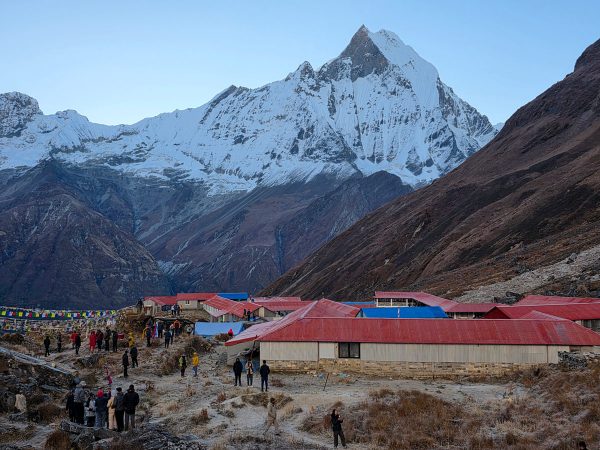
Annapurna Base Camp Trek with Helicopter Return - 11 Days
Price on Request
Trek through the beautiful Annapurna region, passing rhododendron forests and traditional villages, before reaching the stunning Annapurna Sanctuary and flying back by helicopter.

ABC Trek with Heli Return Highlights
- Drive through scenic hills, river valleys, and countryside landscapes from Kathmandu to Pokhara.
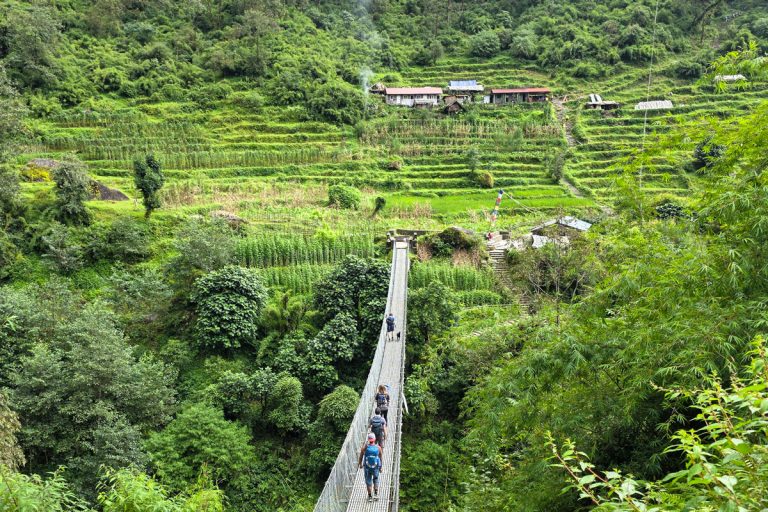
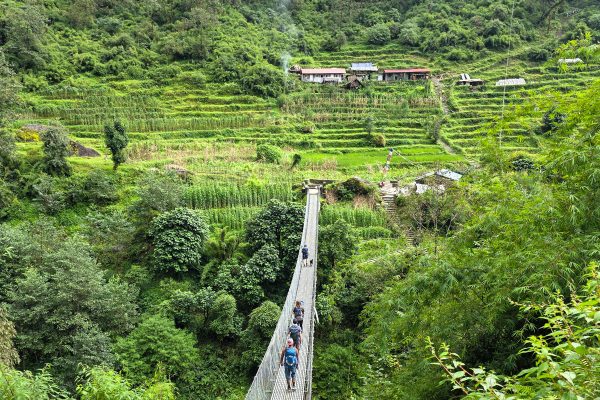
- Trek through traditional villages, terraced farmlands, and beautiful forest trails.
- Walk through rhododendron forests, bamboo groves, and alpine landscapes of the Annapurna region.
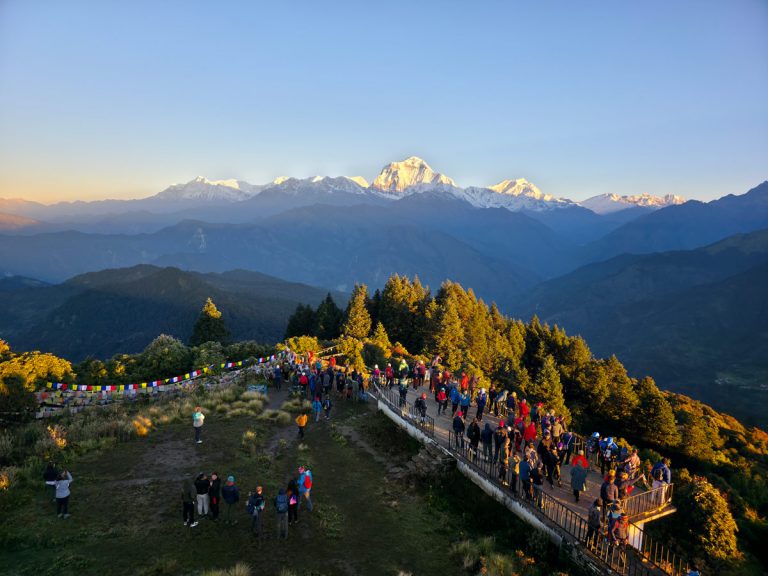
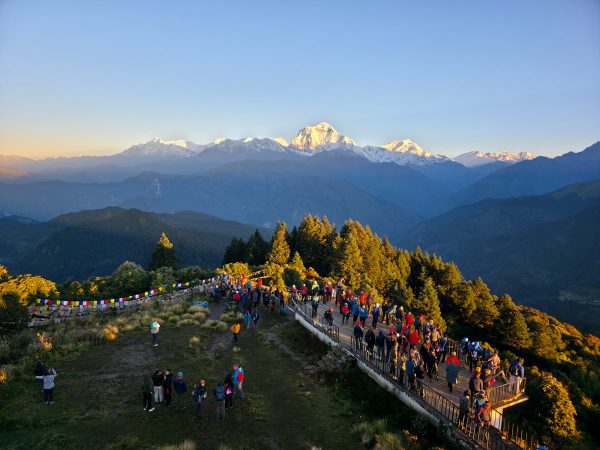
- Hike to Poon Hill for a breathtaking sunrise over the Himalayas.
- Enjoy panoramic views of Annapurna, Dhaulagiri, Machhapuchhre, and Hiunchuli peaks.
- Visit Machhapuchhre Base Camp (MBC) before reaching Annapurna Base Camp (ABC).
- Reach the heart of the Annapurna Sanctuary surrounded by towering snow-capped peaks.
- Capture unforgettable sunrise and sunset views over the Annapurna massif.
- Experience the natural beauty and peaceful atmosphere of the Annapurna region.
- Immerse yourself in the warm culture and traditions of the Gurung and Magar communities along the trail.
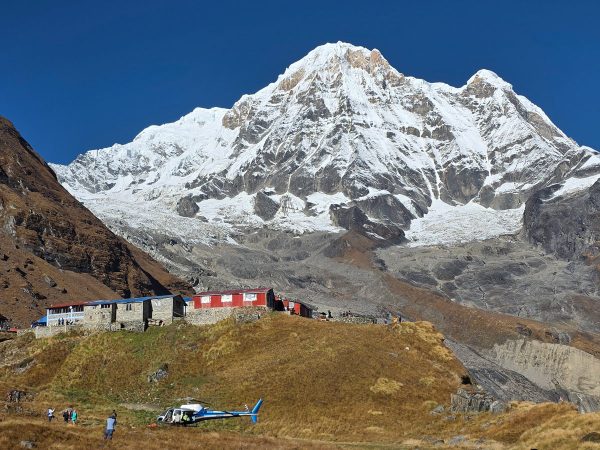
- Enjoy a scenic helicopter flight from Annapurna Base Camp to Pokhara.
ABC Trek with Helicopter Return Overview
The Annapurna Base Camp Trek with Helicopter Return combines one of Nepal’s most iconic trekking routes with the comfort and thrill of a scenic helicopter flight back from the heart of the Himalayas.
This Annapurna Base Camp (ABC) trek is perfect for both experienced hikers and adventure-loving beginners who want a shorter, more rewarding itinerary without compromising on views, culture, or experience.
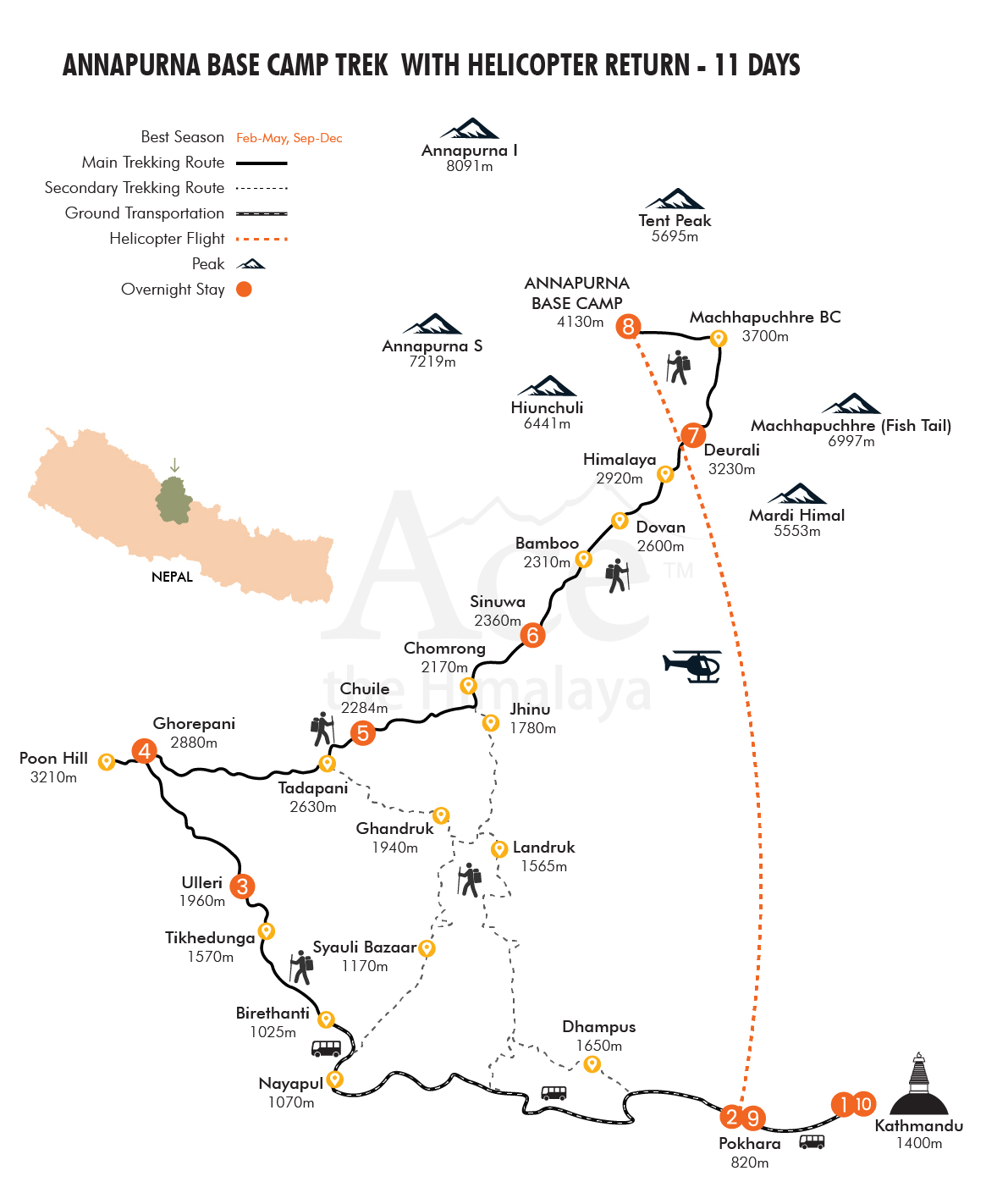
Across just 11 days, you’ll journey from Kathmandu to Pokhara and into the beautiful Annapurna Sanctuary, walking through terraced rice fields, rhododendron forests, bamboo groves, and high-altitude meadows.
The ABC trekking trail passes through traditional Gurung and Magar villages such as Chhomrong, where slate-roofed houses, stone-paved lanes, and warm hospitality offer a genuine glimpse of life in rural Nepal.
Along the way, you’ll share teahouses with local families, taste home-style Dal Bhat, and learn about the unique culture, traditions, and daily rhythms of the mountain communities.
As you gradually ascend through the trail, the scenery changes from lush lowland forest to dramatic alpine landscapes.
Throughout the journey, you’ll be rewarded with spectacular views of the Annapurna Massif, including Annapurna I (8,091 m/26,545 ft), the 10th highest peak in the world, Annapurna South (7,219 m/23,684 ft), Machhapuchhre (6,993 m/22,943 ft), Hiunchuli (6,441 m/21,132 ft), Gangapurna (7,455 m/24,457 ft), and many other towering Himalayan peaks.
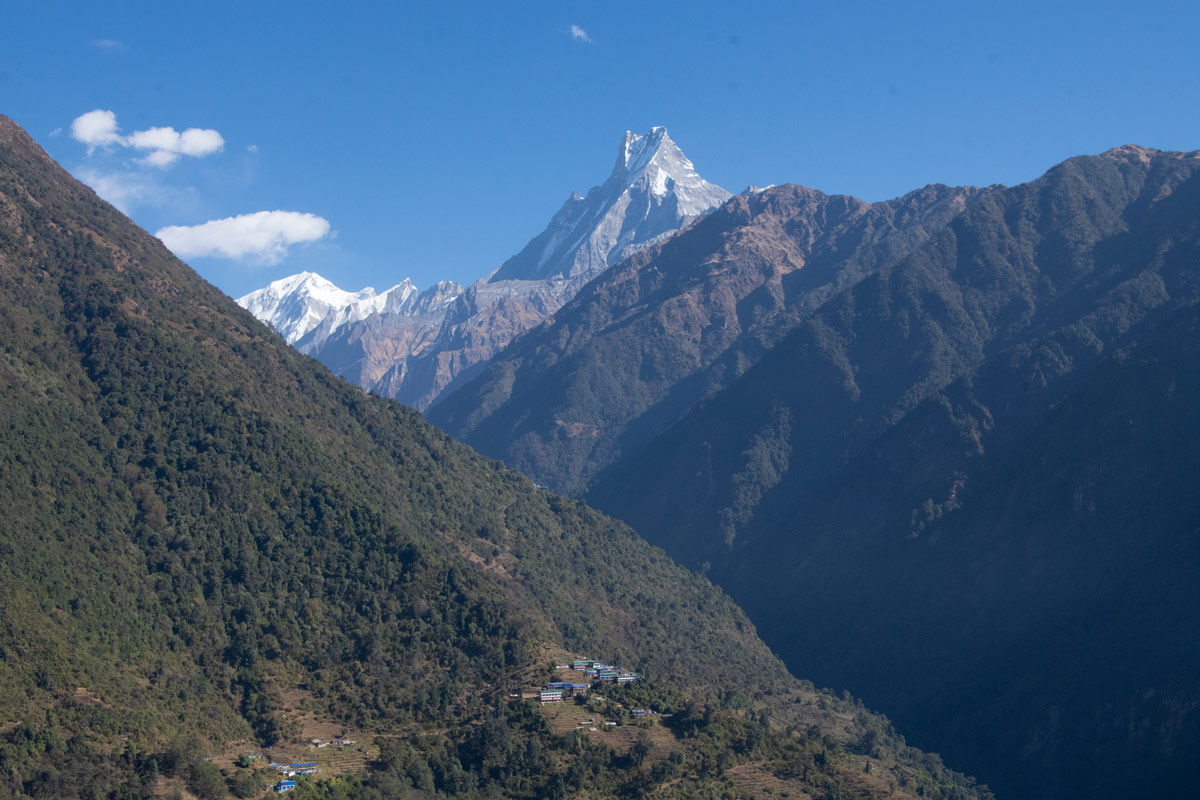
The route leads through peaceful stops like Sinuwa, Doban, Himalaya, and Deurali, and then onwards to Machhapuchhre Base Camp (MBC), where the stunning pyramid peak of Machhapuchhre (Fishtail) dominates the skyline.
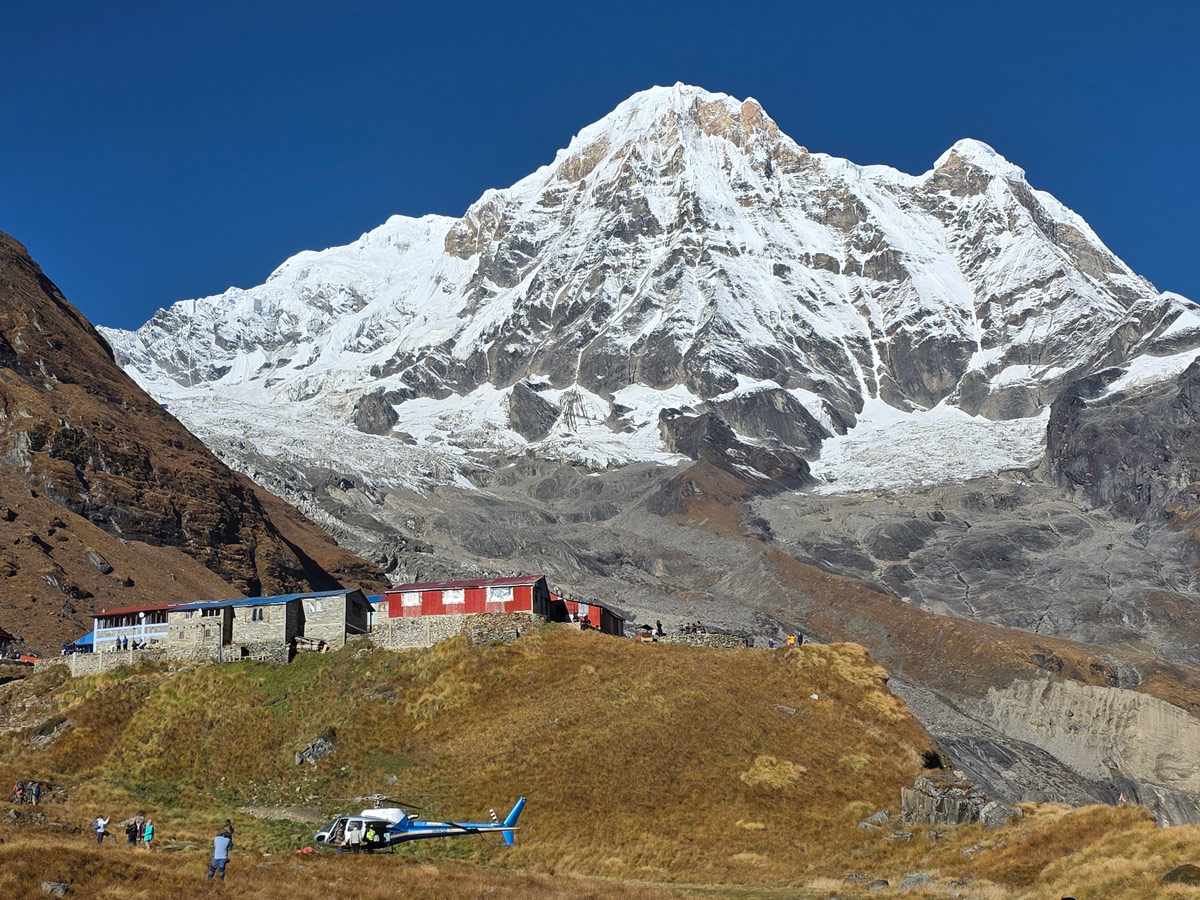
From here, a final push brings you to the natural amphitheatre of Annapurna Base Camp (4,130 m/13,550 ft), the highest point of the trek and the core of the Annapurna Sanctuary.
At ABC, you’re surrounded on all sides by towering giants: Annapurna I (8,091 m/26,545 ft), Annapurna South, Hiunchuli, Gangapurna, Machhapuchhre, and a host of other snow-covered peaks.
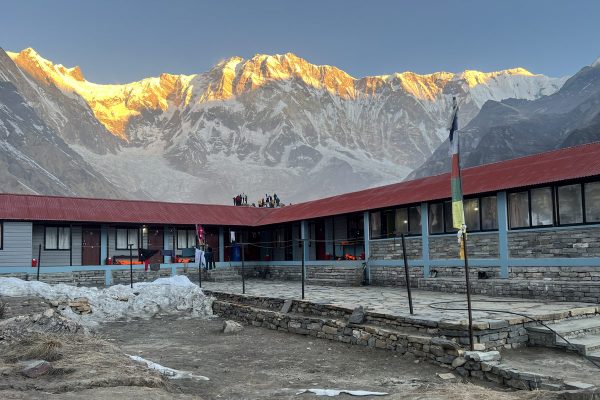
Sunrise here is truly unforgettable, the first light washing over the entire Annapurna Massif and illuminating glaciers, ridges, and sheer walls of ice and rock.
It’s a perfect place to slow down, take photos, and simply sit in silence, absorbing the scale and beauty of the mountains.
Instead of retracing the entire route on foot, this itinerary adds a special twist: a helicopter return from the Annapurna region.
After your night at Base Camp, you board a scenic helicopter flight that sweeps you back over the Sanctuary, terraced hillsides, and deep valleys to Pokhara, turning days of descent into an exhilarating, once-in-a-lifetime aerial experience.
This not only saves time and energy but also lets you see the landscapes you trekked through from a completely new perspective.
The journey ends in Pokhara, where you can unwind by Phewa Lake, enjoy cafe culture, or simply sit and watch the mountains you’ve just visited reflected in the water, before returning to Kathmandu.
Short Itinerary
Arrival at Tribhuvan International Airport in Kathmandu (1,400 m/4,593 ft) and transfer to hotel. Overnight at 3-star hotel.
Drive to Pokhara (820 m/2,690 ft) from Kathmandu in a Tourist Bus – 7 to 9 hours. Overnight at 3-star hotel.
Drive to Birethanti (1,025 m/3,363 ft) from Pokhara – 1 hour and Trek to Ulleri (1,960 m/6,430 ft) – 4 to 5 hours. Overnight at a guesthouse.
Trek to Ghorepani (2,880 m/9,449 ft) from Ulleri – 5 to 6 hours. Overnight at a guesthouse.
Early morning hike up to Poon Hill (3,210 m/10,531 ft) & back and then trek to Chuile (2,284 m/7,493 ft) – 7 to 8 hours. Overnight at a guesthouse.
Trek to Sinuwa (2,360 m/7,740 ft) from Chuile – 6 to 7 hours. Overnight at a guesthouse.
Trek to Deurali (3,230 m/10,597 ft) from Sinuwa – 6 to 7 hours. Overnight at a guesthouse.
Trek to Annapurna Base Camp (4,130 m/13,550 ft) from Deurali – 5 to 6 hours. Overnight at a guesthouse.
Morning Sightseeing around Annapurna Base Camp and Heli Flight to Pokhara – 20 to 30 minutes. Overnight at 3-star hotel.
Drive to Kathmandu (1,400 m/4,593 ft) from Pokhara in a Tourist bus – 6 to 8 hours. Overnight at 3-star hotel.
Transfer to the International Airport for your final departure.
Departures & Availability
Looking for personalized experience? We organize privately guided journey which is mainly designed to fit your taste and interest. We allow complete flexibility on your departure date, please choose your preferable date.
Price Includes
Accommodation
- Twin-sharing/double accommodation in a 3-star hotel in Kathmandu for 2 nights. (Private room accommodation can be organized at an extra cost)
- Twin-sharing/double accommodation in a 3-star hotel in Pokhara for 2 nights. (Private room accommodation can be organized at an extra cost)
- Twin-sharing guesthouse accommodation up to Lower Sinuwa and dormitory-style guesthouse accommodation beyond Lower Sinuwa in the Annapurna region for 6 nights.
Meals & Drinking Water
- All your standard meals during the trek (Breakfast, Lunch, and Dinner) including seasonal fruits
- Fresh seasonal fruits each day after dinner during the trek.
- A farewell dinner on the last night in Nepal.
- Purified drinking water during the trek using Water Filter or water purification tablets.
Transportation and Helicopter Flight
- All (international and domestic) airport transfers on a tourist vehicle
- Tourist bus between Kathmandu and Pokhara
- Private tourist vehicle from Pokhara to Birethanti
- Helicopter flight from Annapurna Base Camp to Pokhara airport
Guide and Staff
- Experienced, wilderness first-aid trained, government licensed, English speaking, and locally recruited Ace the Himalaya’s trekking guide (2 guides for group size more than 7 people).
- Porters during the trek for carrying luggage (1 porter for every 2 clients)
- Wages, accommodation, meals, gear, insurance, and medications for all staff
Permits
- Annapurna Conservation Area Permit
- TIMS (Trekkers’ Information Management System) card
Benefits and Takeaways
- 1 Ace the Himalaya’s duffel/kit bag, trekking map, sun hat, Buff (Neck Gaiter)
- A comprehensive first aid kit, including an Oximeter to check pulse and oxygen levels daily in the mountains
- Trip completion certificate
Administrative & Taxes
- All administrative expenses and government taxes
Price Excludes
- Meals (lunch and dinner) in Kathmandu and Pokhara
- International flight fare and airport departure tax
- Nepal Entry Visa (Visa can be acquired easily after your arrival at Tribhuvan International Airport in Kathmandu with a fee of USD 30 for 15 days visa, USD 50 for 30 days visa and USD 125 for 90 days visa)
- Travel insurance along with high-altitude emergency evacuation coverage
- Any beverages including bottled and boiled water
- Tips to trekking staff and driver
- Personal trekking gear and equipment
- Any expenses other than the Price Include section
Annapurna Base Camp Trek with Helicopter Return Itinerary
Expand AllDay 01: Arrival at Tribhuvan International Airport in Kathmandu and transfer to hotel.
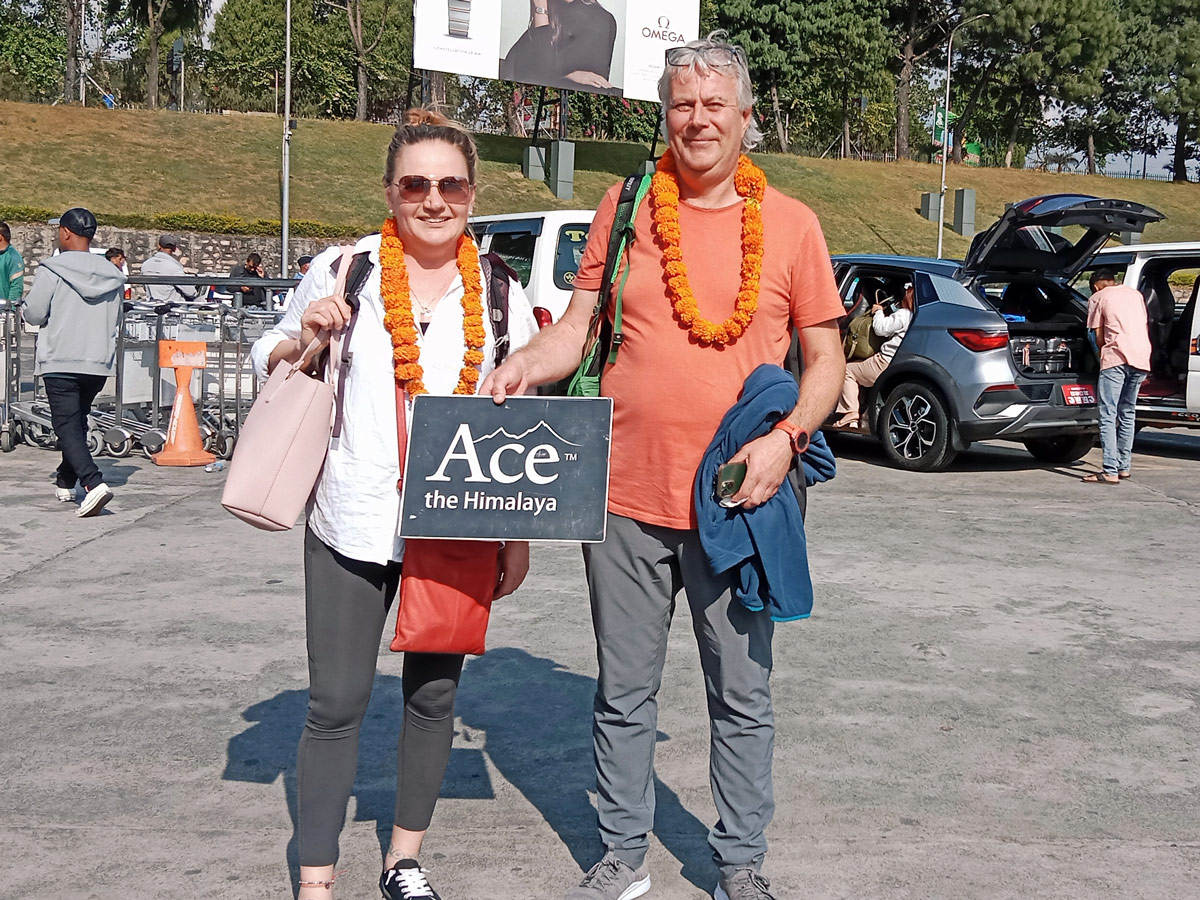
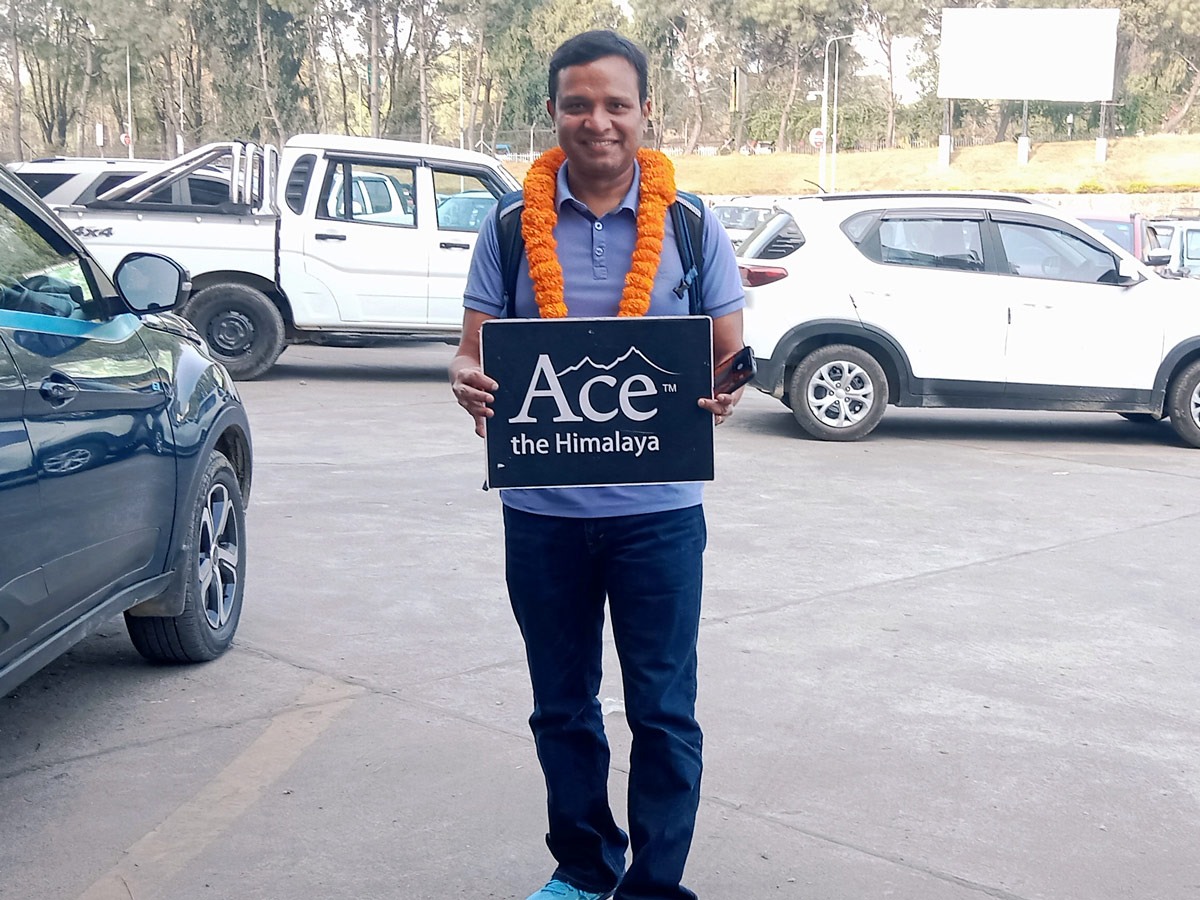
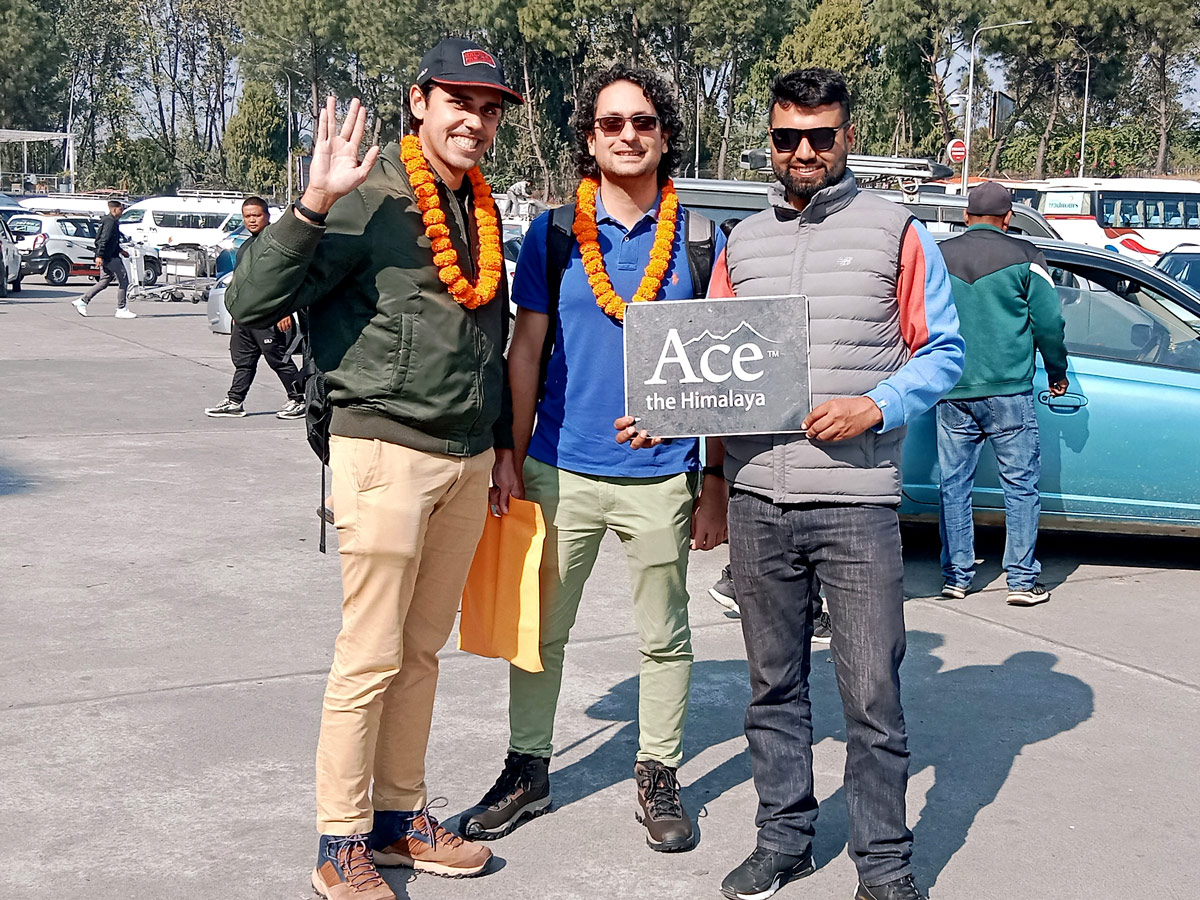
One of our team members will be waiting to welcome you at Tribhuvan International Airport, Kathmandu, upon your arrival. From there, you’ll be transferred to your hotel in a comfortable private tourist vehicle.
Note: Before the trek commences, we will arrange a pre-trip meeting where you’ll have the opportunity to meet your experienced trip guide and company members in the office premises or at your hotel residence.
This meeting serves as an important orientation, allowing you to ask any questions and address any concerns you may have about trekking in the mountains with one of our team members.
They will provide valuable insights and essential information to ensure you are fully prepared and excited for the adventure ahead.
Day 02: Drive to Pokhara from Kathmandu in a Tourist Bus.
Your trekking guide will meet you at your hotel around 6:30 AM and escort you to the tourist bus station. The drive to Pokhara, departing at approximately 7:00 AM, is a beautiful journey in itself.
As you follow the Prithvi Highway, you’ll enjoy changing views of winding rivers, terraced hillsides, lush valleys, and small roadside towns, offering a first glimpse of the landscapes that define the Annapurna region.
Nestled in the foothills of the Himalayas, Pokhara is Nepal’s premier tourist and adventure hub, framed by a spectacular mountain backdrop.
On a clear day, you can see Annapurna and Machhapuchhre (Fishtail) rising to the north, Dhaulagiri to the west, and Lamjung Himal and Manaslu to the east.
With its relaxed lakeside vibe, stunning scenery, and close proximity to the mountains, Pokhara is the perfect gateway for the Annapurna Base Camp trek, giving you a soft landing before the real adventure on the trail begins.
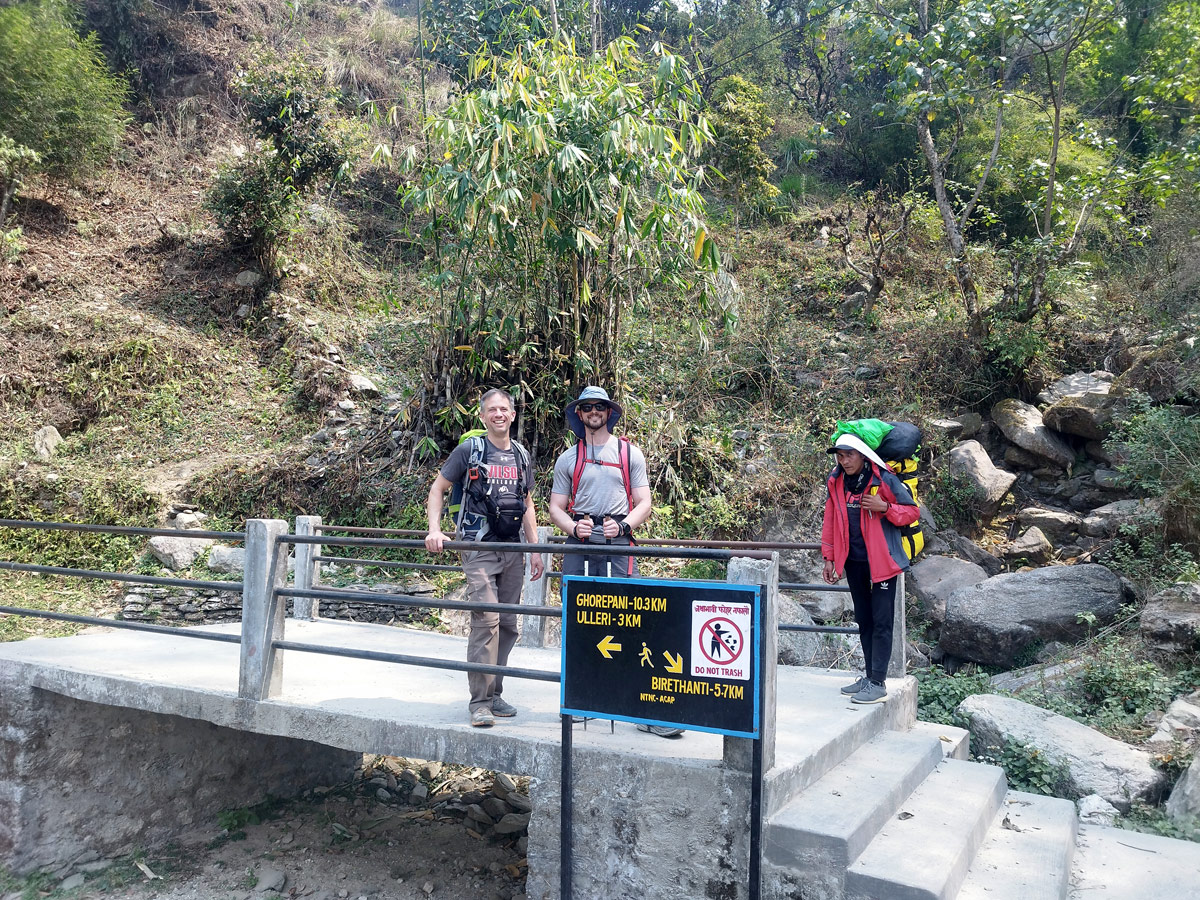
Day 03: Drive to Birethanti and Trek to Ulleri
On this day, you leave Pokhara by private vehicle and drive toward the trailhead.
After around 2 to 4 hours following scenic roads through terraced hillsides and river valleys, you arrive at Birethanti (1,039 m/3,409 ft), a charming riverside village that marks the start of your Annapurna trekking adventure.
From here, you begin walking along a gentle trail and, after a couple of hours of gradual ascent, reach Hile (1,495 m/4,905 ft), a sizeable village with several shops and teahouses, an ideal place to take a short rest, enjoy some refreshments, and soak in the surroundings.
You then continue your hike toward Ulleri, a traditional Magar village known for its stone staircases and hillside homes.
Today’s walk is designed as a short and relatively easy introductory trekking day, helping you ease into the rhythm of the trail, get used to the terrain, and experience what trekking in the Nepalese hills feels like before heading deeper into the Annapurna region.
Day 04: Trek to Ghorepani from Ulleri
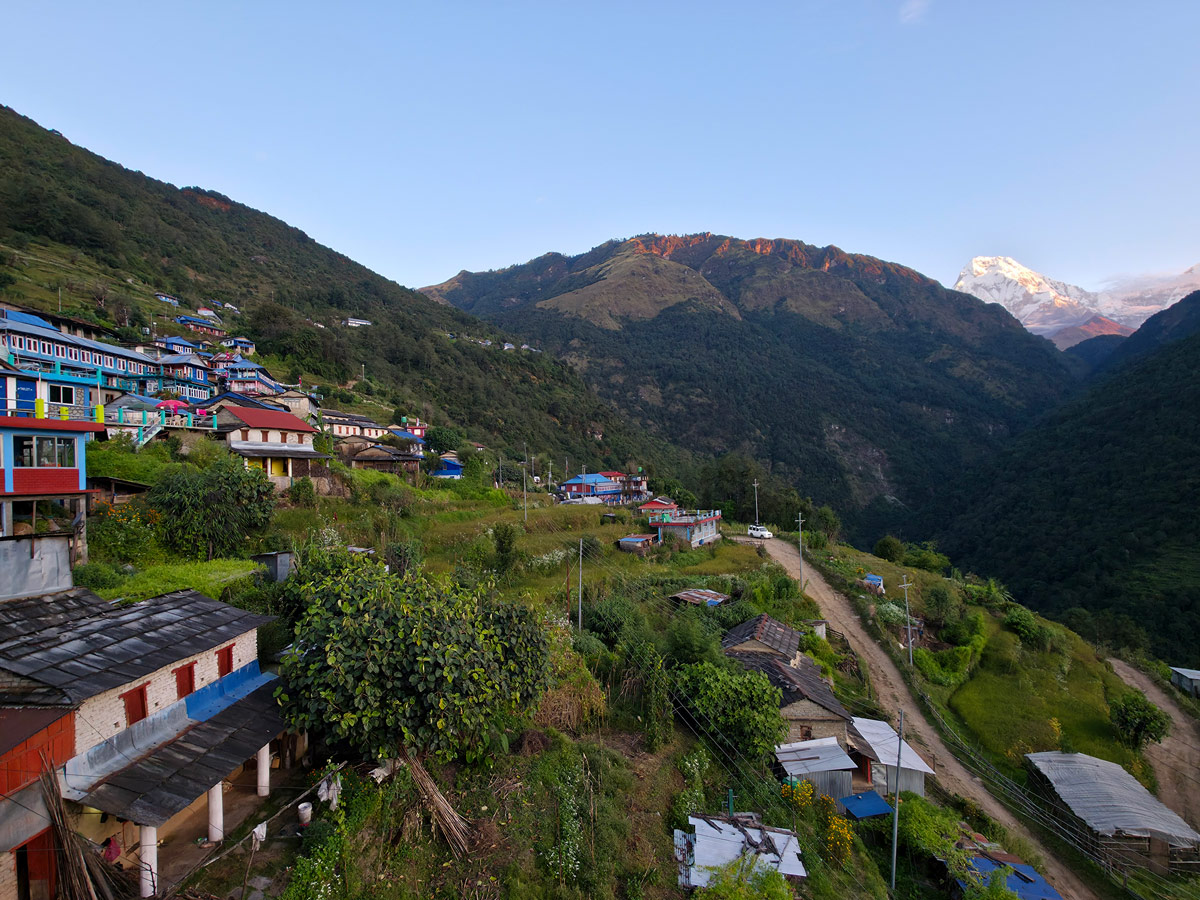
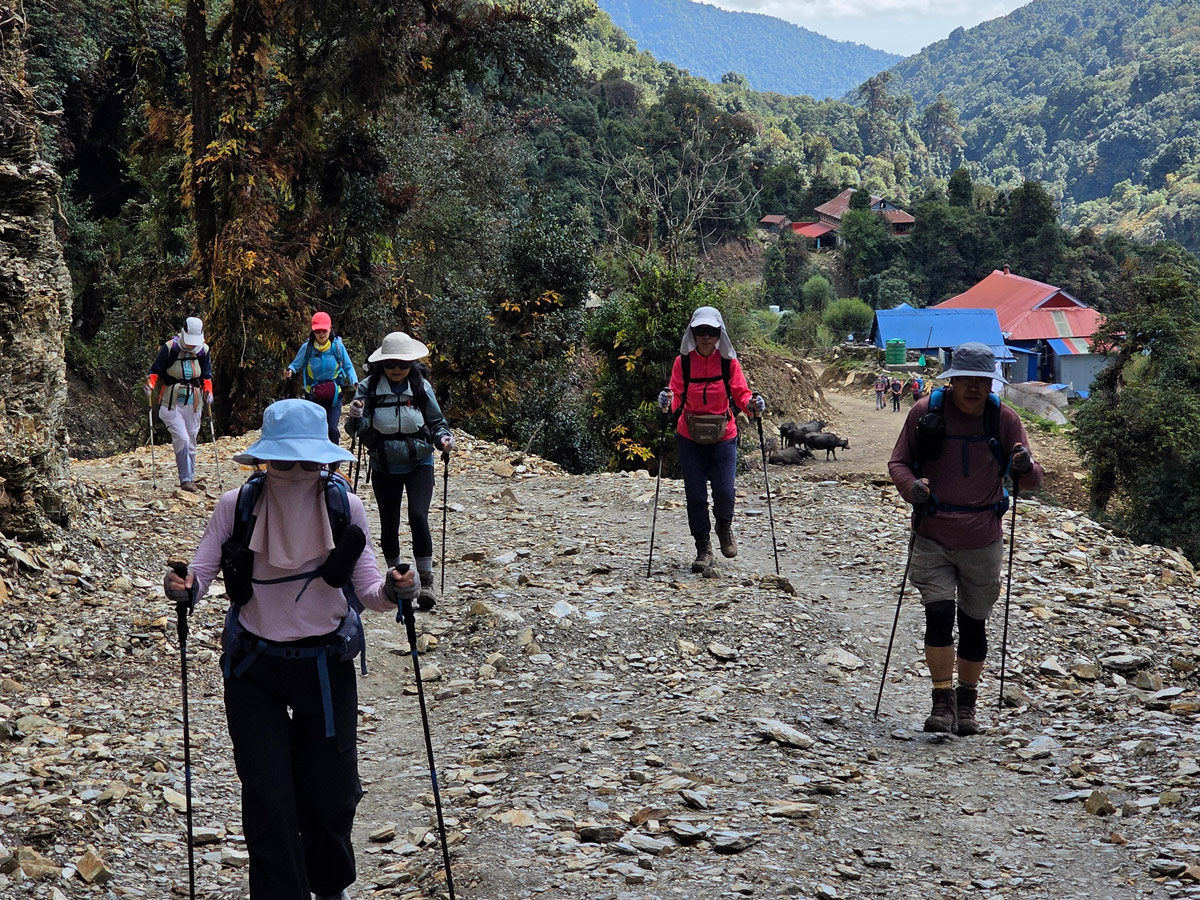
From Ulleri, you continue your ascent toward Ghorepani, a well-known scenic village perched at 2,880 m (9,449 ft).
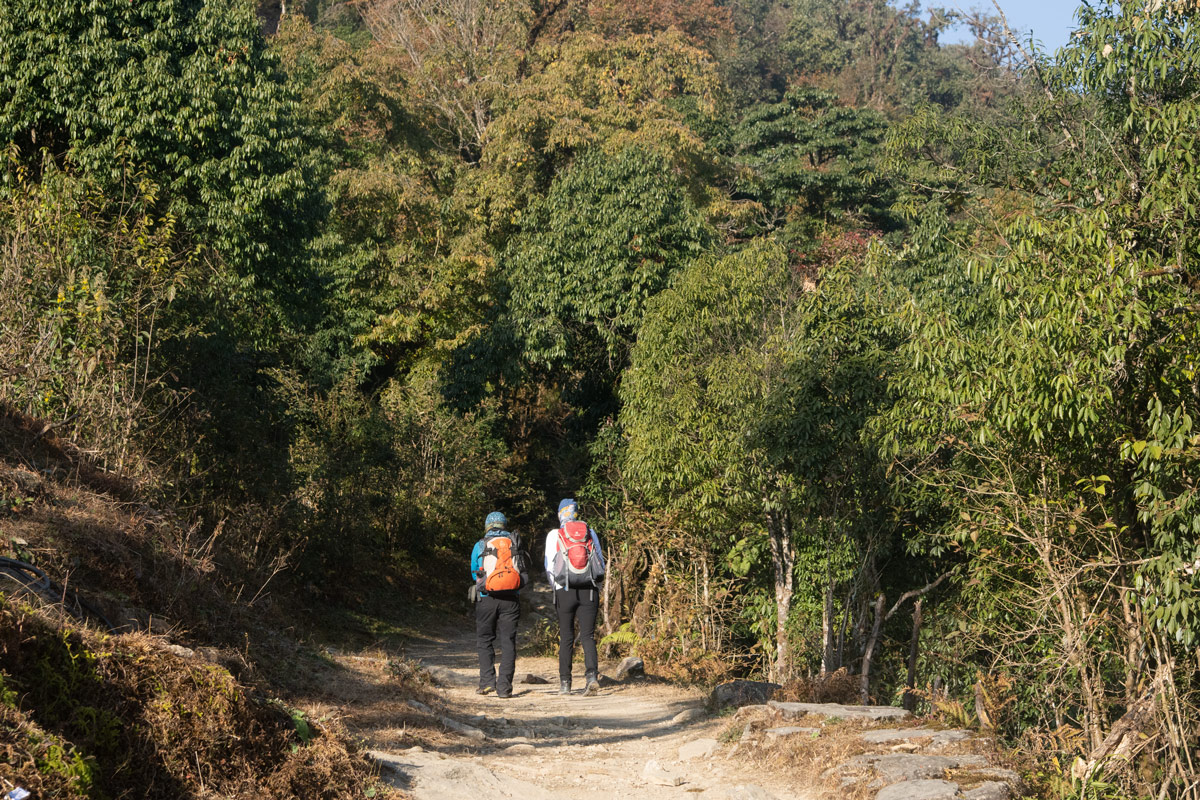
The trail climbs more gradually now, leading you through beautiful forests of oak and rhododendron, where the landscape feels increasingly peaceful and remote.
You pass through Banthanti (2,250 m/7,382 ft) and then continue on to Nangethanti (2,460 m/8,071 ft), a pleasant stopping point often used for a short break.
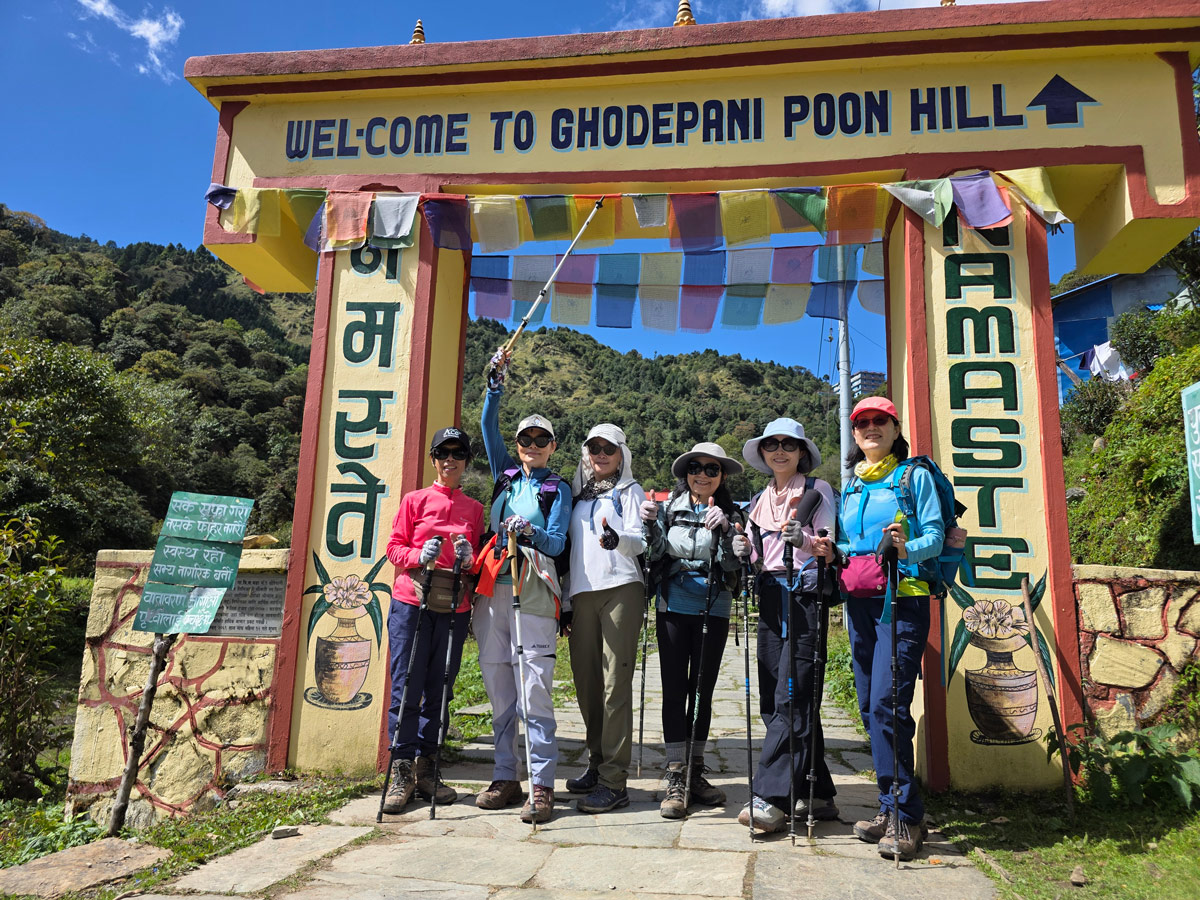
From here, it’s roughly another hour of steady walking before you reach Ghorepani, your destination for the night, a colorful mountain village known for its views and its role as the gateway to the famous Poon Hill sunrise.
Day 05: Early morning hike up to Poon Hill & back and then, trek to Chuile
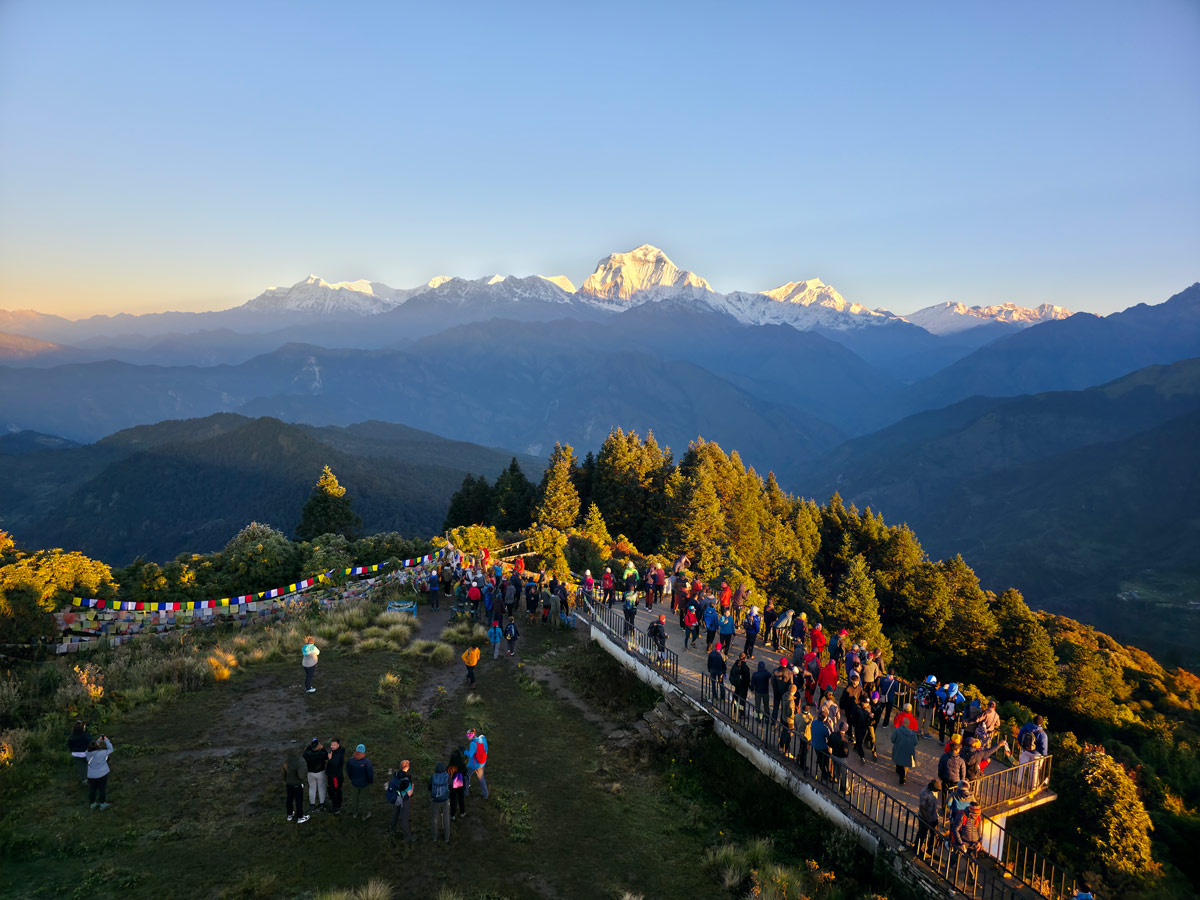
Today, very early in the morning, we start an hour or two hike to Poon Hill (3,210 m/10,531 ft). The place is a brilliant mountain range spectacle. This vantage point provides an unobstructed view of the sunrise over the high Himalayas.
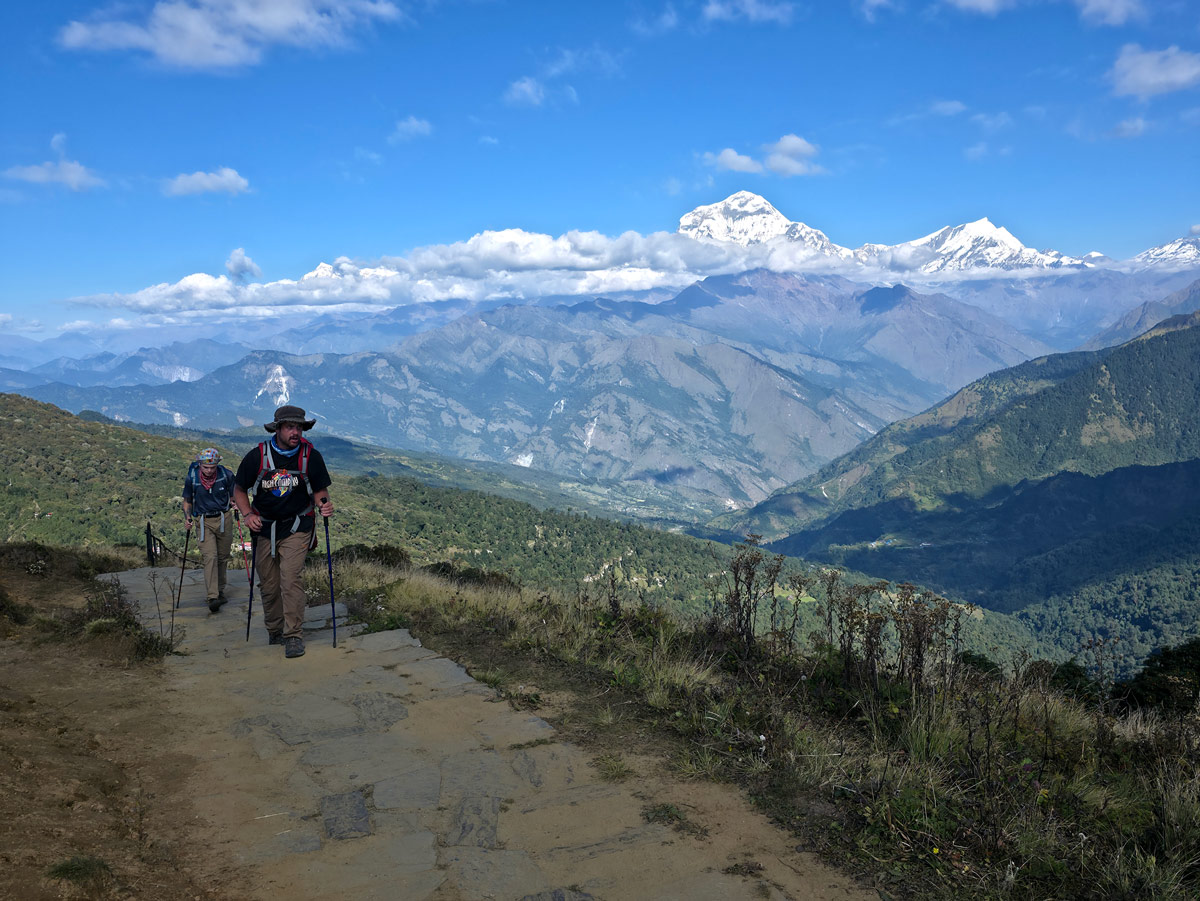
From the top of Poon hill, you can enjoy panoramic views of Annapurna (8,091m), Dhaulagiri (8,127m), Machhapuchhre (6,993 m), Annapurna South (7,219 m), Himchuli and other Himalayan peaks.
We spend some time at the viewpoint for sunrise photography and mountain views before hiking back down to Ghorepani for a hot breakfast.
After breakfast, we continue the trek through forested trails, ridges, and beautiful rhododendron and pine forests toward Deurali (2,960 m/9,711 ft). From there, the trail descends toward Banthanti, where we stop for lunch.
After lunch, we climb from Banthanti toward Tadapani and then continue further to Chuile with a scenic descentthrough rhododendron forests.
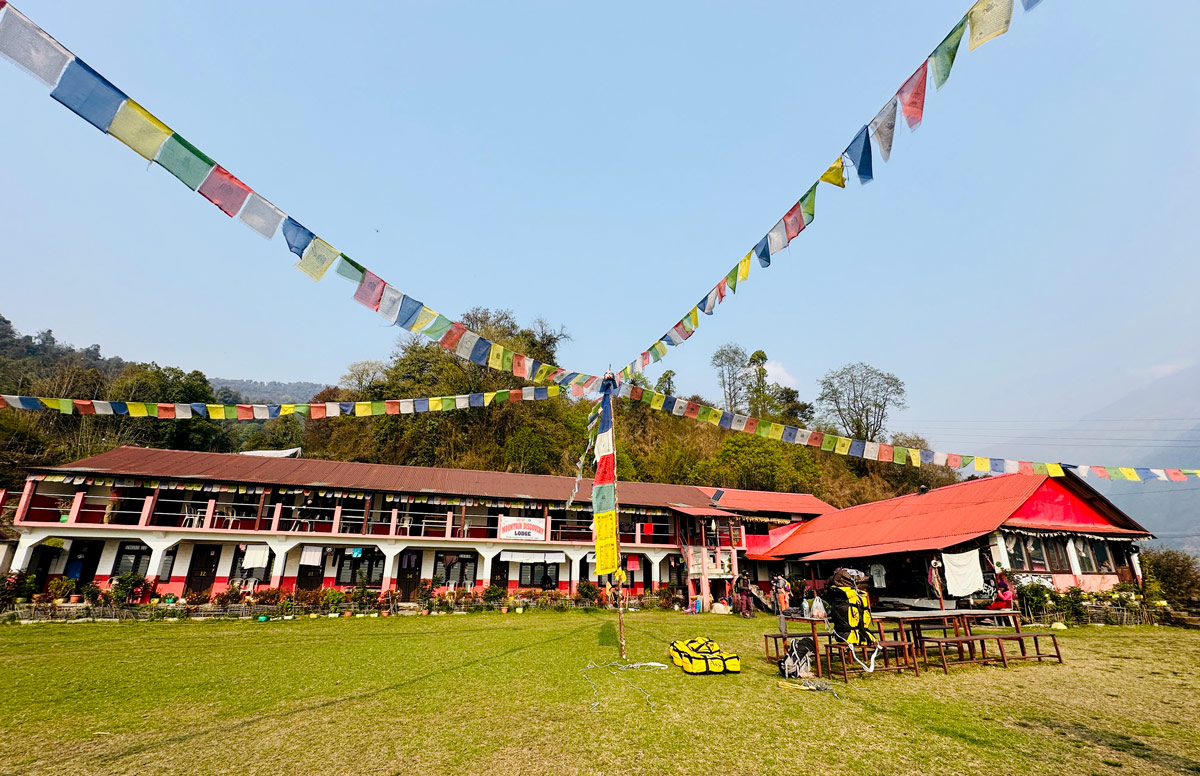
Day 06: Trek to Sinuwa from Chuile
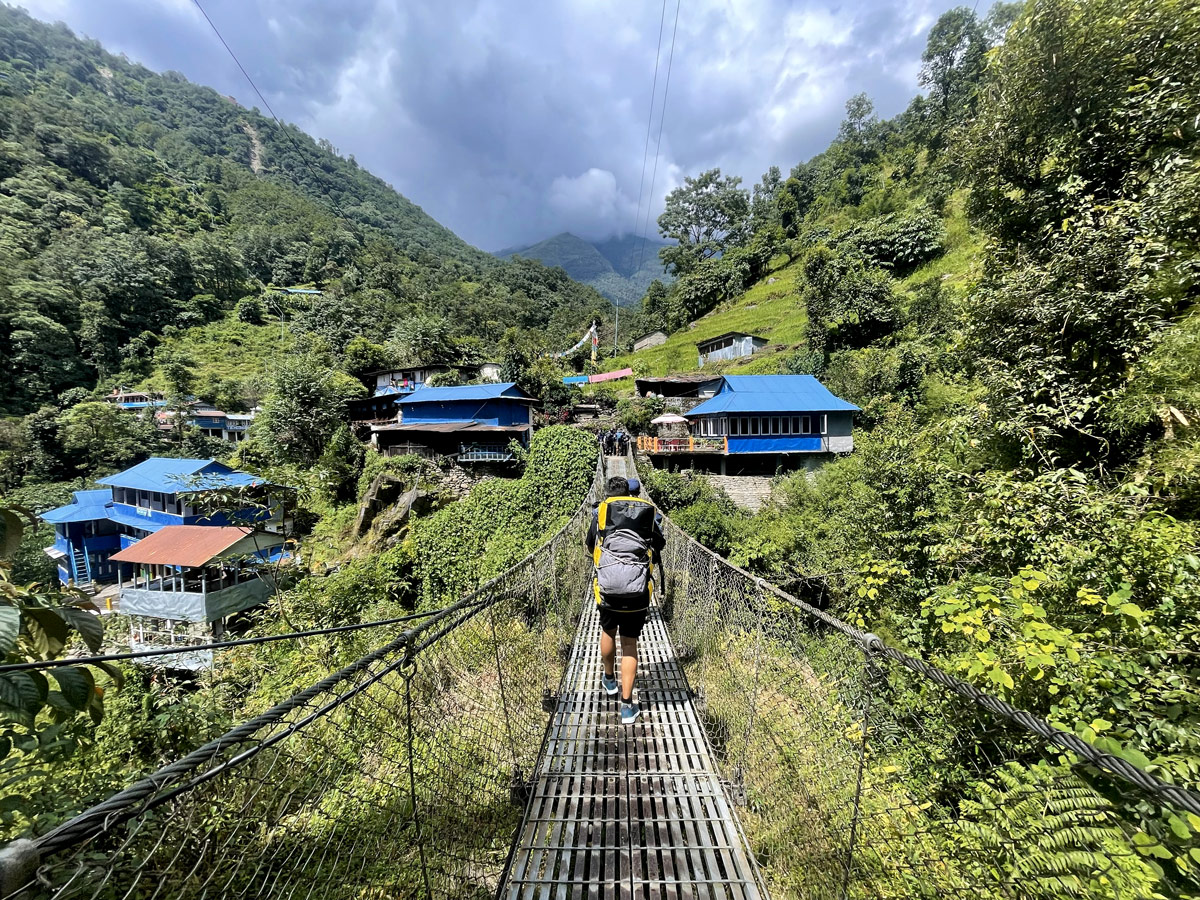
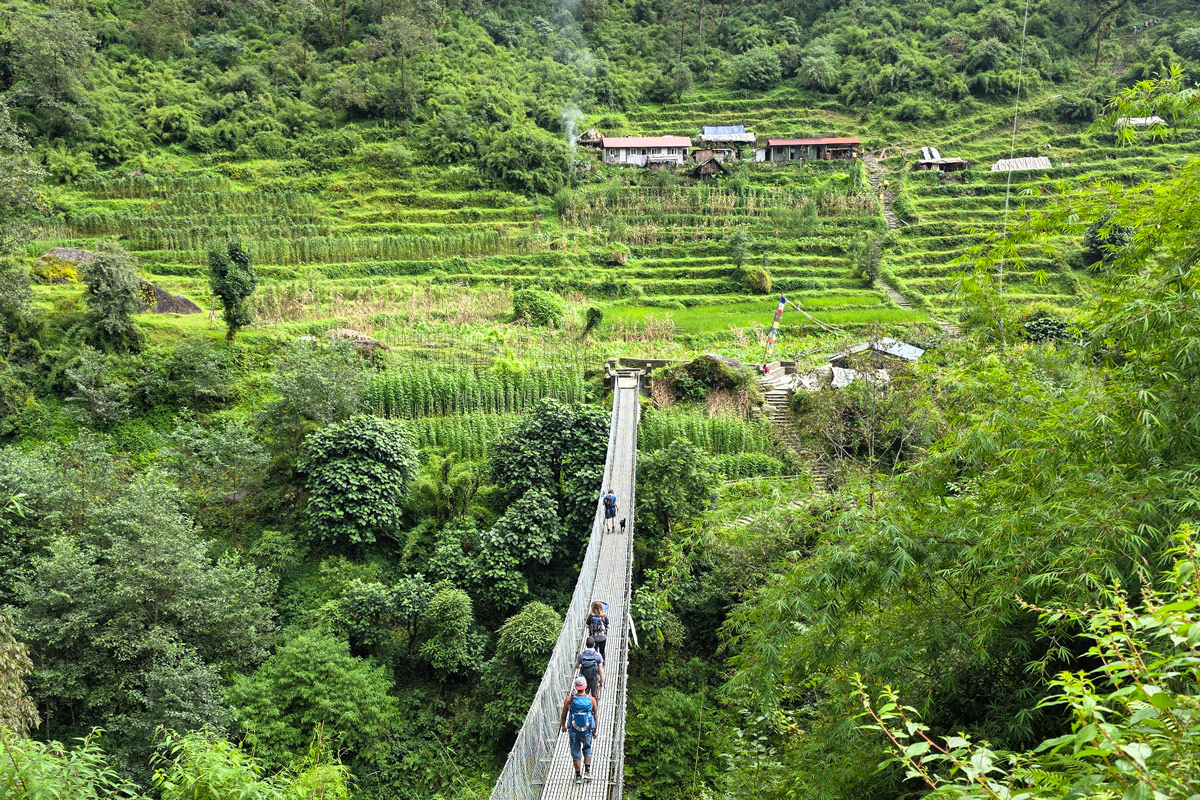
Today we begin our trek from Chuile, following a trail that gradually leads us through forested sections and across suspension bridges.
From Chuile, the route leads us to an uphill climb toward Ghurjung village, passing through peaceful surroundings and traditional settlements along the way.
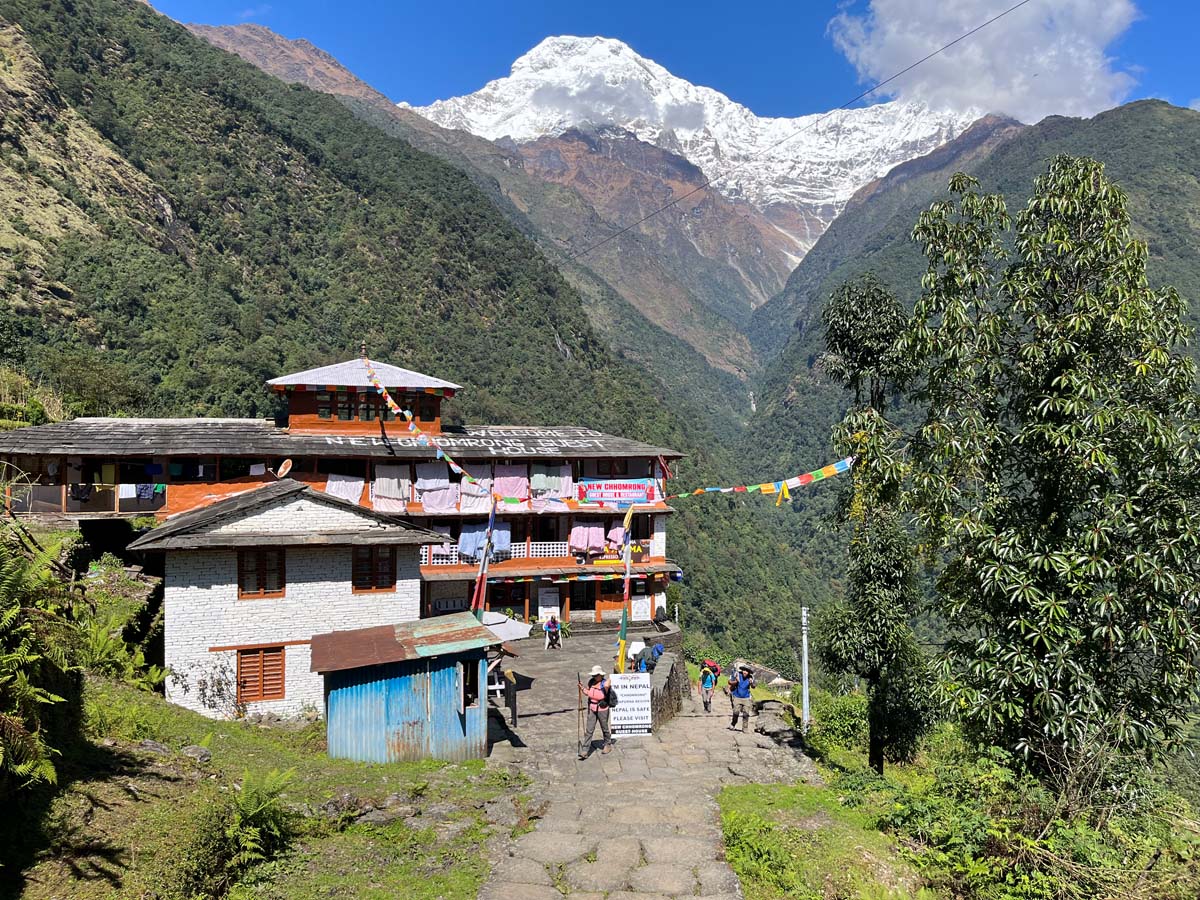
Continuing on, we reach Chhomrong, where we stop for lunch and take some time to rest while enjoying views of the surrounding mountains and valley.
After lunch, the trail descends steeply down stone steps to the Chhomrong Khola River. Once we cross the river, a challenging uphill climb through dense forest brings us to Sinuwa.
Day 07: Trek to Deurali from Sinuwa
Today’s Annapurna trekking trail begins with a gradual climb from Sinuwa to Upper Sinuwa, gaining a bit more height as you follow a well-trodden forested path.
After a hearty breakfast in Sinuwa, you begin your trek toward Deurali, following a trail that starts with a steady climb before dropping down to the peaceful rest stop of Bamboo.
Here, the path leads through dense rhododendron forests and bamboo groves, with occasional openings that reveal distant views of the towering Annapurna Massif.
Continuing onward, you pass through Dovan (2,600 m/8,530 ft) and Himalaya (2,920 m/9,580 ft), both set in narrow valleys surrounded by steep, forested slopes and dramatic rock walls.
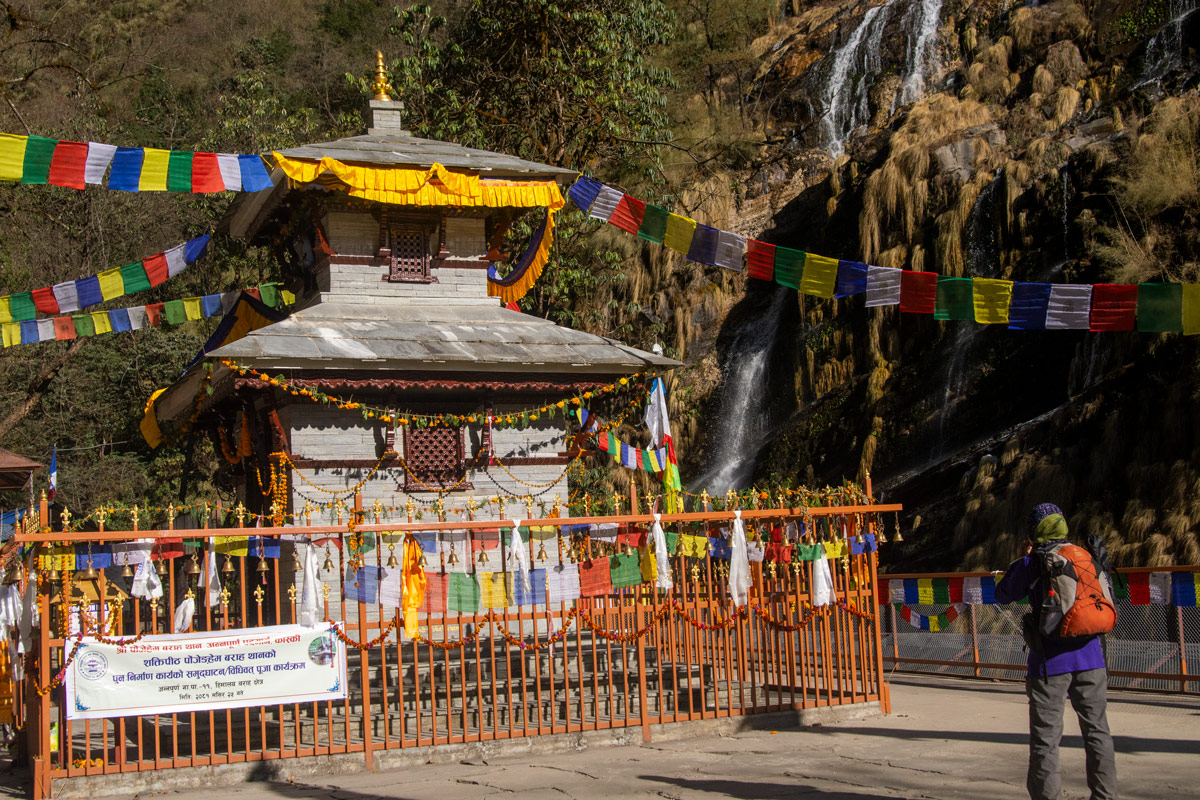
After Dovan, you reach the Pujinim Barah Temple and a tranquil waterfall, a perfect place to pause, refill your bottle, and enjoy the cool, refreshing atmosphere.
As you climb higher, the gorge begins to widen and the landscape gradually shifts from dense forest to more open, alpine terrain, with increasingly panoramic views of the Himalayas.
The trail then passes by Hinko (Hinku Cave), a natural rock overhang, before you make the final approach to Deurali.
On arrival, you’ll notice the change in environment: crisper air, sparser vegetation, and broad views of snow-capped peaks surrounding the valley.
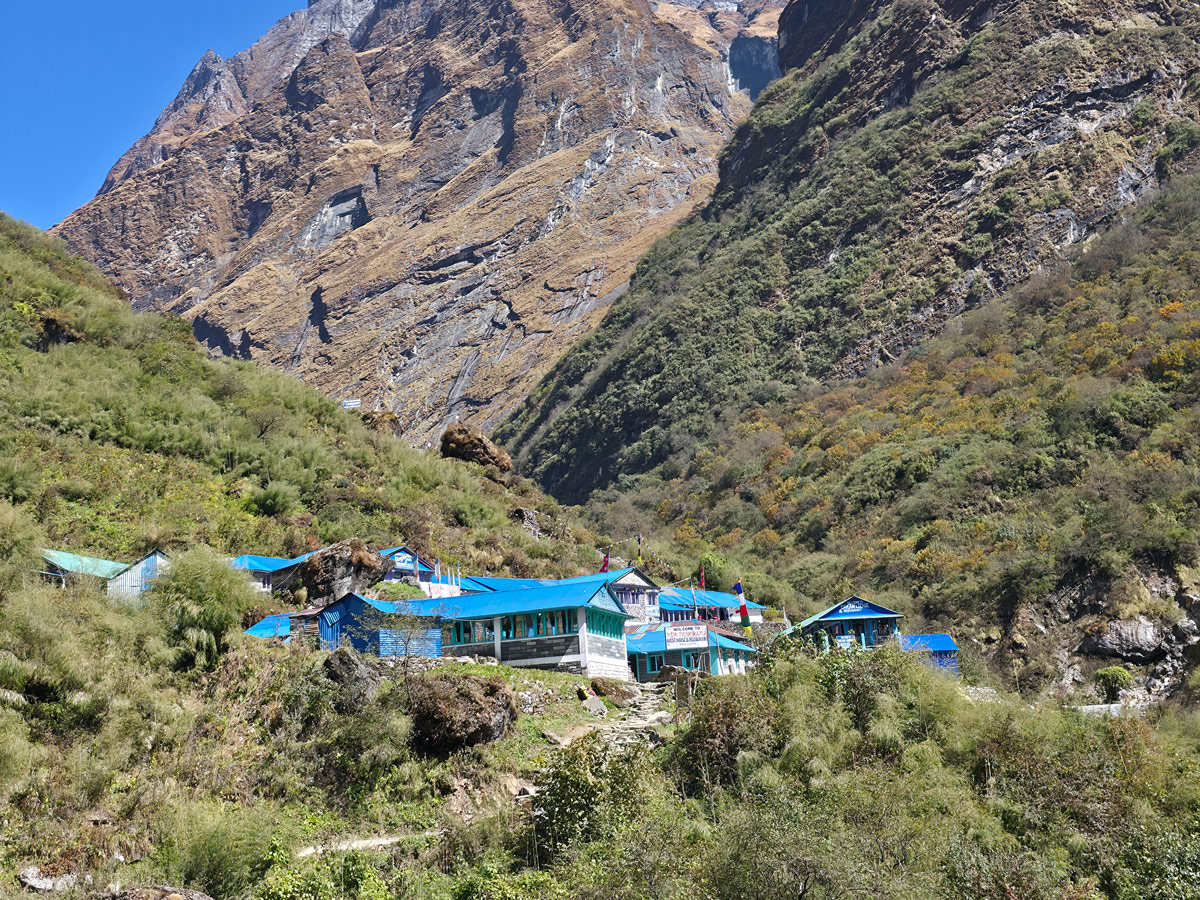
Deurali is your stop for the night, a quiet, scenic place to rest, enjoy a warm meal, that brings you one step closer to the Annapurna Sanctuary and take in the serene beauty of the mountains before heading closer to Annapurna Base Camp.

Day 08: Trek to Annapurna Base Camp from Deurali
After a warm breakfast in Deurali, you begin one of the most rewarding days of the entire journey, the hike into the heart of the Annapurna Sanctuary and up to Annapurna Base Camp (ABC).
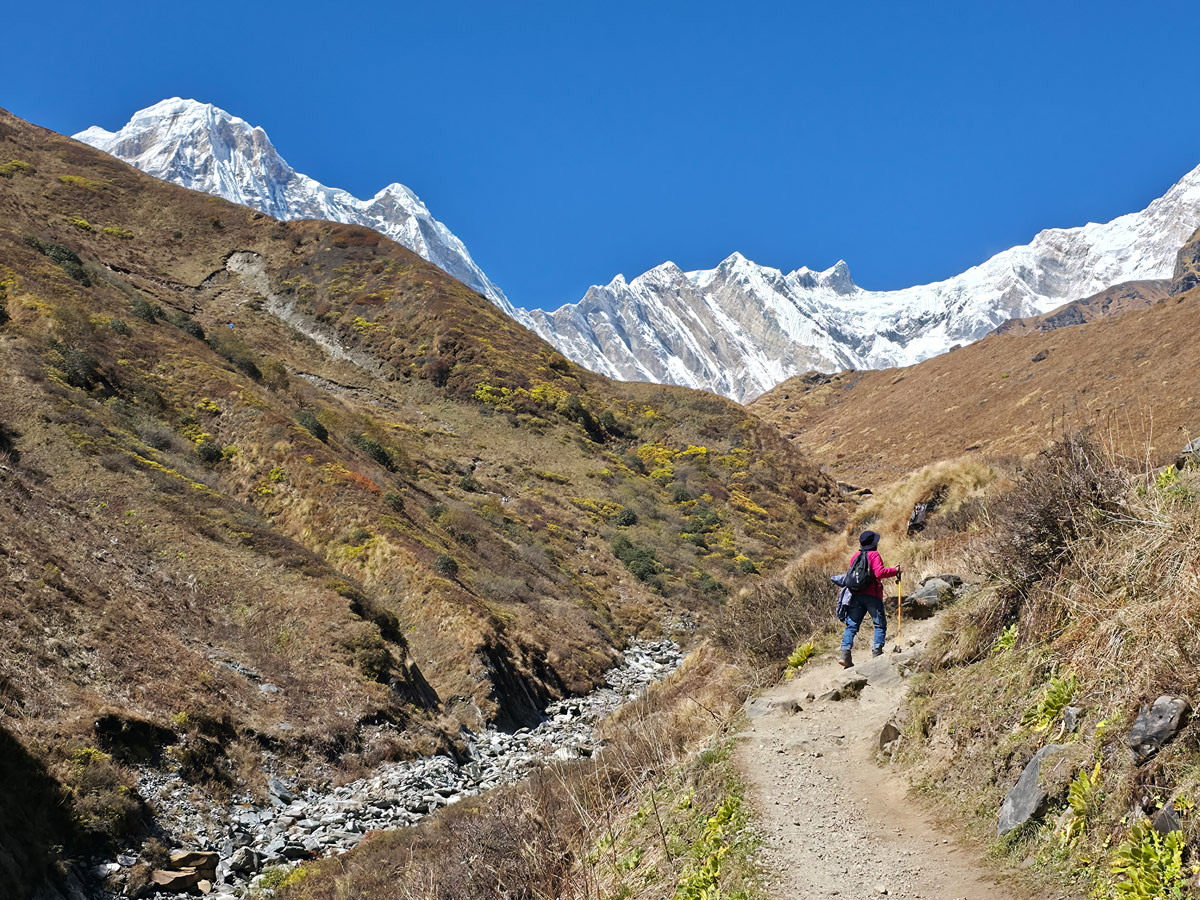
The trail gently follows the valley, gradually climbing along, short ups and downs that slowly gain altitude as you move deeper between steep rock walls and high alpine slopes.
As you walk, the scenery becomes more dramatic with every turn, and the air noticeably cooler and thinner.
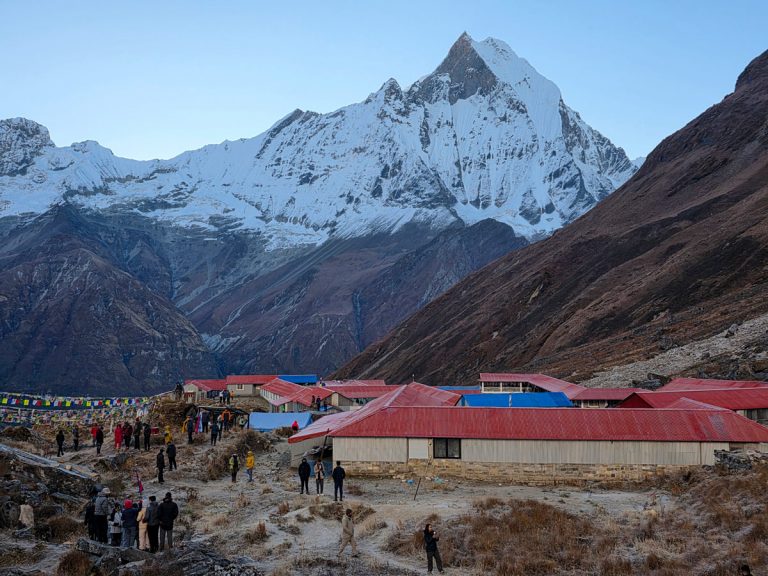
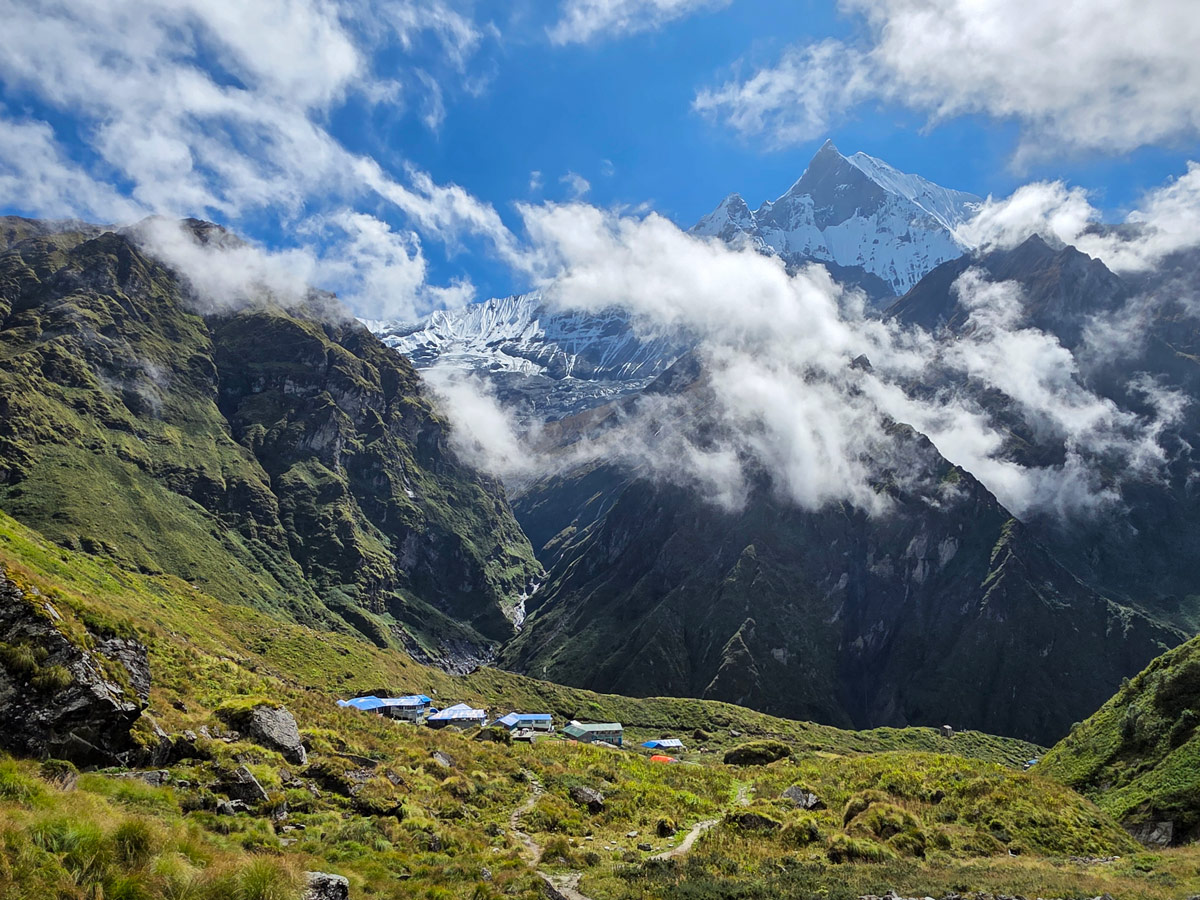
You soon reach Machhapuchhre Base Camp (3,700 m/12,139 ft), a spectacular spot at the foot of Machhapuchhre (Fishtail).
Here, the striking pyramid-shaped peak rises directly above you, and the views begin to open up to include Annapurna South, Hiunchuli, and neighboring ridges. It’s a natural place to pause for a rest and soak in the mountain atmosphere.
From MBC, the trail climbs steadily but comfortably across open meadows and glacial moraines.
With height comes ever-expanding views: the Annapurna Massif begins to wrap around you, and the valley widens into the famous Sanctuary amphitheater.
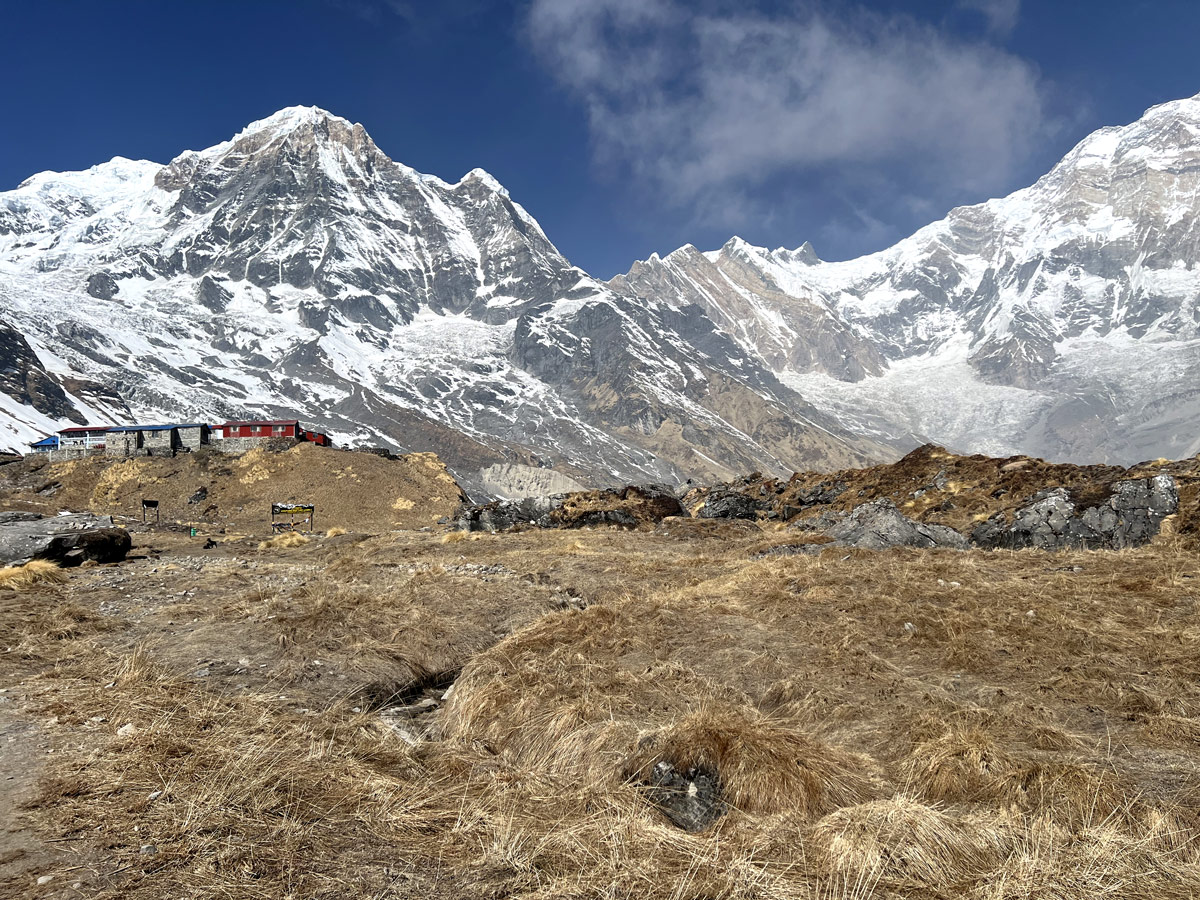
By the time you reach Annapurna Base Camp (4,130 m/13,550 ft), you are completely encircled by towering peaks – Annapurna I, Annapurna South, Hiunchuli, Machhapuchhre, Gangapurna, and several other snow-covered summits form a near 360-degree wall of rock and ice.
ABC offers one of the most impressive viewpoints in all of Nepal, and every step taken to get here feels justified.
You can wander around the base camp area, capture photos, and absorb the sense of scale and quiet that defines this high Himalayan bowl.
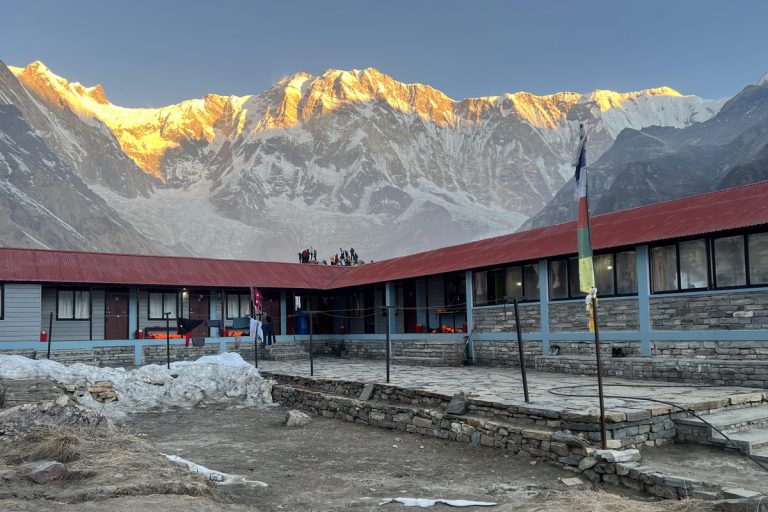
As evening approaches, the colours on the peaks shift from white to gold to soft pink, and the Sanctuary takes on a calm, almost otherworldly atmosphere.
After dinner at the guesthouse, you can step outside for a bit of stargazing before turning in resting at Annapurna Base Camp, ready for sunrise the next morning.
Day 09: Sunrise at Annapurna Base Camp and Helicopter Flight to Pokhara
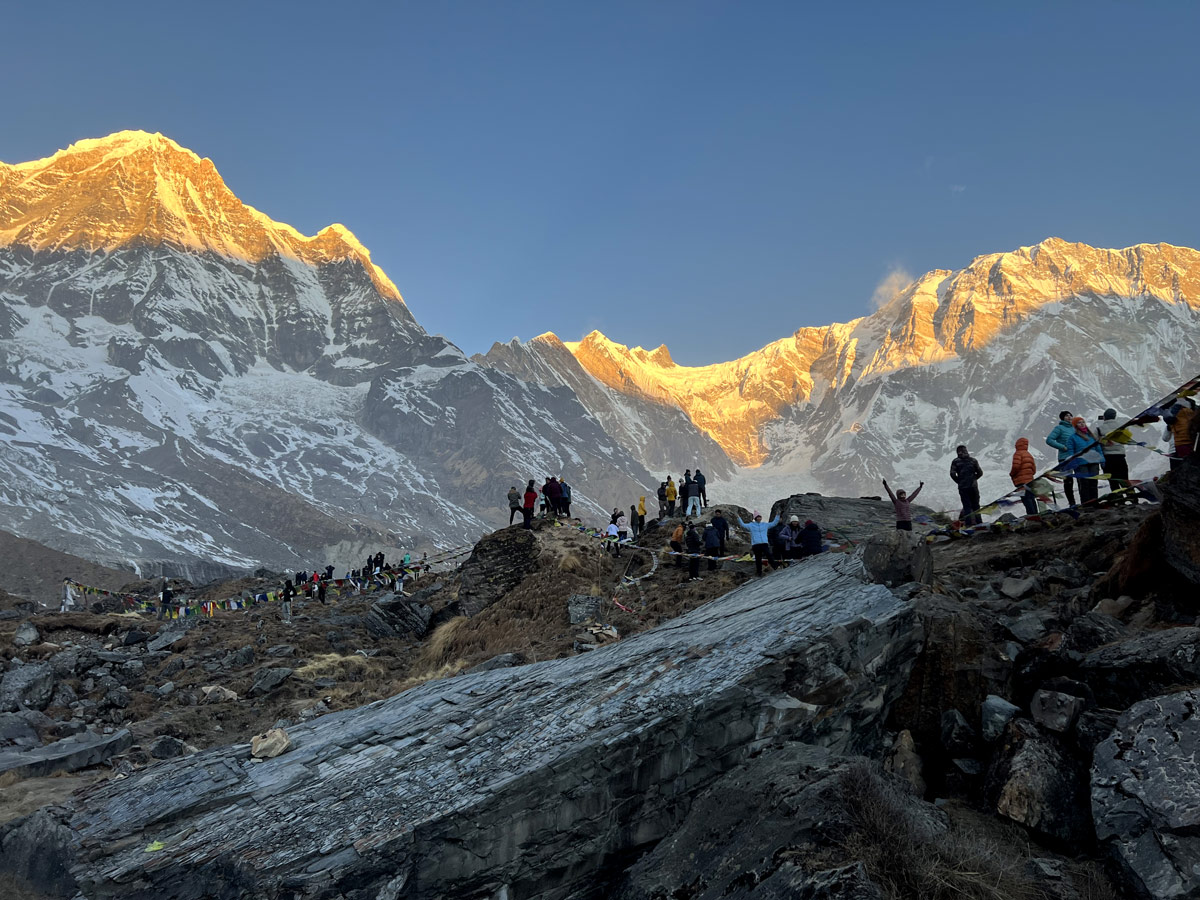
You wake up early today for one of the absolute highlights of the trek, a sunrise at Annapurna Base Camp.
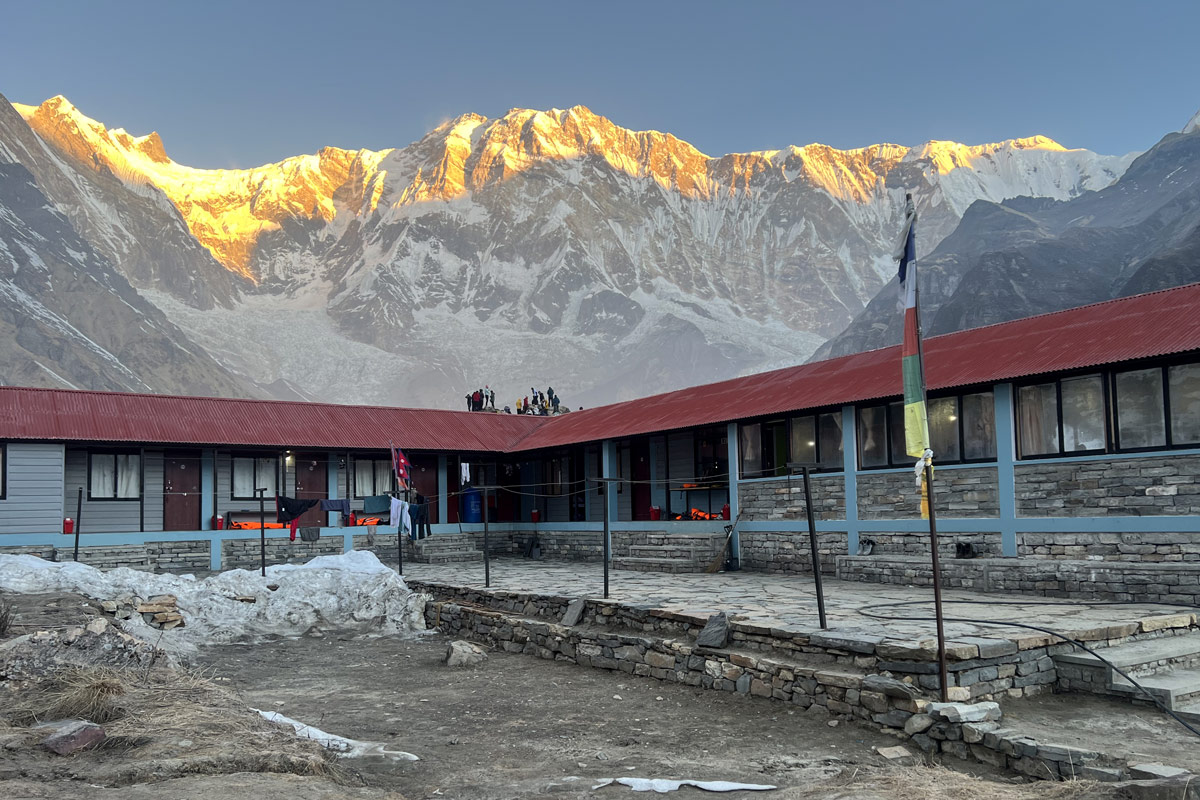
As the first light touches the horizon, the entire Annapurna massif gradually lights up, with Annapurna I, Annapurna South, Hiunchuli, and Machhapuchhre glowing in soft orange and gold.
The glaciers, ridgelines, and surrounding walls of rock come alive with colour, creating a full 360-degree panorama you’ll never forget.
After taking plenty of photos and enjoying the stillness of the morning, you return to the lodge for a hot breakfast.
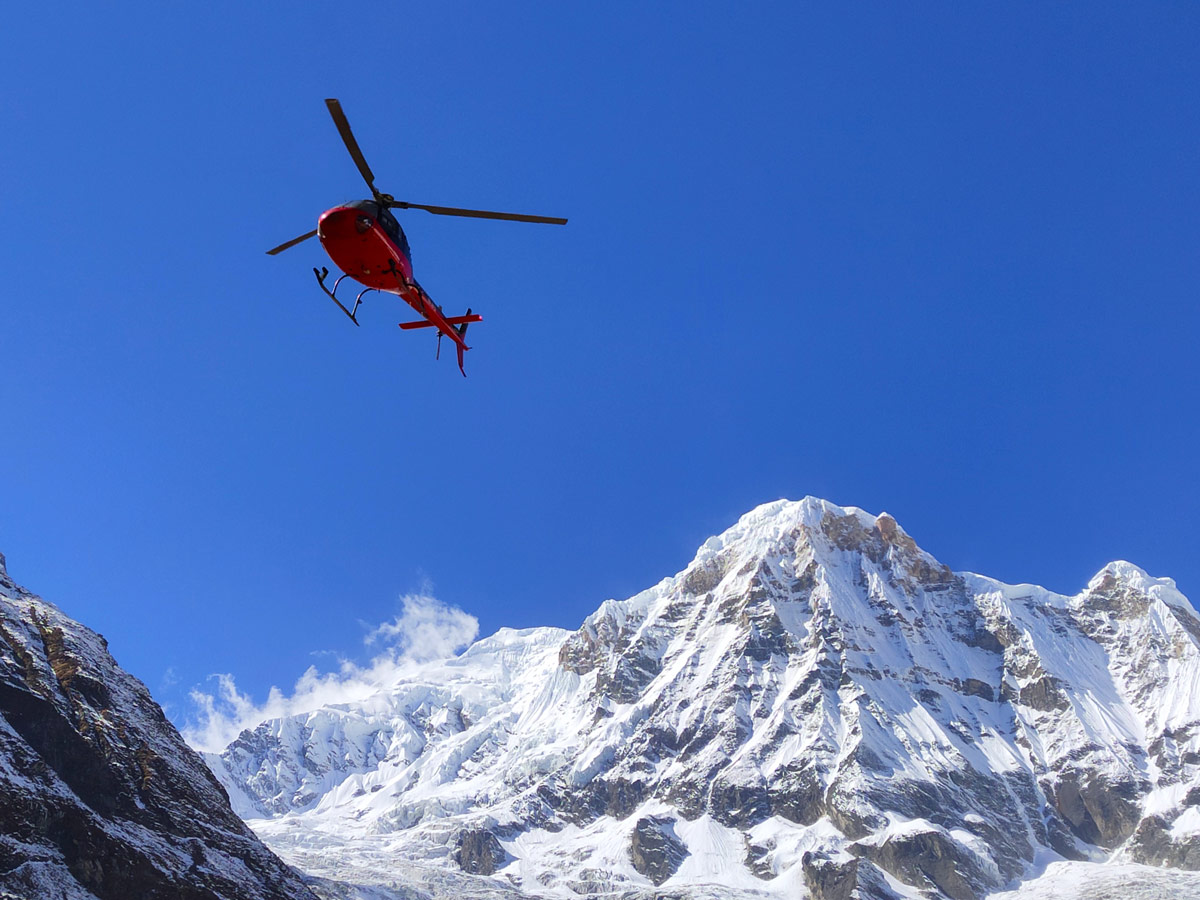
With the hardest trekking behind you, today marks the beginning of a very special finale to your journey, a scenic helicopter flight back to Pokhara.
Once ready, you walk a short distance to the designated helipad area near ABC.
After a brief safety orientation, you board the helicopter and lift off from the Sanctuary, watching Annapurna Base Camp shrink below you as the chopper rises above the surrounding peaks.
The flight offers a unique aerial perspective of everything you’ve just walked through the natural bowl of the Annapurna Sanctuary, the dramatic faces of Annapurna I and Machhapuchhre,the deep valley carved by the Modi Khola along with terraced hillsides and scattered villages leading toward Pokhara.
In a single, thrilling journey, you glide from the high Himalaya back to the lush mid-hills and finally into the broad valley of Pokhara, with Phewa Lake glinting below.
After landing in Pokhara, you’ll be transferred to your hotel. The rest of the day is free to rest or stroll along Lakeside, enjoy a cafe or restaurant, or simply sit by the water reflecting on your time at Annapurna Base Camp.
Day 10: Drive to Kathmandu from Pokhara
After early breakfast in Pokhara, you begin your scenic drive back to Kathmandu, a journey of around 6 to 8 hours along the winding Prithvi Highway.
The road from Pokhara to Kathmandu follows the course of the Trishuli River, with sweeping views of green hills, river valleys, terraced fields, and small roadside towns that offer one last taste of Nepal’s countryside.
On arrival in Kathmandu, you’ll be transferred to your hotel, where you can freshen up, rest, or take a short stroll through nearby streets and markets.
In the evening, you’ll gather with your guide and a company representative to celebrate the completion of your Annapurna Base Camp trek with heli return.
To mark the end of your adventure, we’ll escort you to a special farewell dinner with your guide.
It’s a relaxed and memorable final night in Nepal, reflecting on the journey you’ve just completed in the heart of the Himalayas.
Day 11: Transfer to the International Airport for your final departure
One of Nepal’s most iconic trekking adventures, your Annapurna Base Camp Heli trek comes to a close today.
After breakfast and any last-minute shopping or relaxing at your hotel, our airport representative will pick you up and transfer you to Tribhuvan International Airport for your onward flight.
As you leave Kathmandu, you’ll carry with you not just photos of the Annapurna Sanctuary and Base Camp, but lasting memories of the mountains, culture, and people of Nepal.
Gears and Equipment
Here is an essential list of what you might want to pack for the thrilling Annapurna Base Camp with Helicopter return trek. Please take this as a starting point. You’ll need layers of warmer clothing during the winter.
We provide a 75-liter Ace the Himalaya duffel bag for you to use for the trek along with a Neck Gaiter and a cap. It will be provided to you during your pre-trip meeting in Kathmandu.
Also, once you are in Kathmandu, you can rent a sleeping bag and down jacket with us at an additional fee of USD 35 for each.

General
- Puffy down jacket (We have rental jackets available for an additional USD 35)
- Four-season (zero degree) sleeping bag (We have rental sleeping bags available for an additional USD 35)
- Daypack (35-45 liters recommended) with rain cover
- Sleeping bag liner

Upper Body
- Sun hat or cap (We’ll provide you with a free Ace the Himalaya baseball cap.)
- Knitted hat/Beanie
- Scarf or neck gaiter
- Headlamp
- Sunglasses

Torso
- Technical fabric base layer (light for warmer months, heavy for colder months)
- Technical fabric short (2) and long sleeve (2) shirts
- Waterproof, windproof shell
- Fleece jacket or pullover

Lower Body
- Technical fabric base layer (light for warmer months, heavy for colder months)
- Hiking pants (2)
- Comfortable pants for inside the teahouses
- Waterproof/windproof outer shell pants
- Hiking shorts

Hands
- Wool or technical fabric liner gloves
- Hard-shell outer gloves (insulated for colder months)

Feet
- Wool or technical fabric warm socks
- Hiking socks
- Liner socks (optional such as silk)
- Trekking/hiking boots (waterproof recommended)
- Ice Cleats /Micro Spikes (For trekking from November to March, it’s recommended to include Ice Cleats/ Micro Spikes to prevent slipping on icy or wet surfaces.)
- Casual shoes
- Gaiters (lightweight for dust or heavy for snow in colder months)
Undergarments
Note: The quantity of each article of clothing can be adjusted to suit the preferences of each participant.
- Technical fabric/quick drying is best for underwear (opportunities to launder during the trip)
- Sports bras (women)
- Pajamas or sleeping clothes

First Aid Kits and Medications
Note: Guides carry medications and first aid kits during the trip. However, personal kits and medications are highly recommended.
- Sunscreen
- Lip balm
- Ointment
Other Essentials
- Passport
- Extra copies of passport-sized photos
- Reusable water bottle
- Toiletry kits
- Water purification tablets or UV water purifier (if you plan to treat water)
- Hydration bladder
- Towel
- Pillowcase
- Toilet paper (2 rolls)
- High-protein snacks (such as protein bars or nuts)
- Waterproof/dry bags for carrying important documents and money
- Airline tickets (Please leave a copy at our office in Kathmandu. This can be useful if there is a change in the date of the flight.)

Optional
Once in Nepal, if you have the time, you can purchase supplies and gear for hiking. Thamel, Kathmandu’s tourist hub, is home to many shops where you can get a variety of reasonably priced trekking equipment.
- Power bank or extra batteries
- Cameras and mobile phone
- Binoculars
- Cards/book
- Pee bottle/ pee funnel for women
- Trekking poles
- Whistle
- Thermos for hot water
Important Information
- During your pre-trip meeting in Kathmandu, we will give you a free duffel bag and baseball cap. The duffel bag will be used to pack your trekking supplies.
- For every two participants, we assign one porter. The duffel bag, which should weigh around 10 kg/22 lbs, will be carried by the porter throughout the walk.
- To carry your daily necessities like cash, crucial papers, a water bottle or bladder, a camera, toiletries, sunscreen, a notebook, clothing, etc., you must have your daypack (with a waterproof cover).
- You can store your luggage (non-trekking items) at the hotel in Kathmandu.
- A down jacket with a hood is a must for altitudes above 4,000 m to keep warm. You can rent a down jacket for USD 35. Please note that in case of loss or damage, you need to reimburse the cost of USD 200 per item.
- You can rent a 4-season sleeping bag for USD 35. Please note that in case of loss or damage, you need to reimburse the cost of USD 200 per item.
Note: Some clothing, especially form-fitting, figure-hugging items made of elastic material (like yoga pants), may offend locals. Therefore, if you choose to wear these clothes for comfort, please make sure to wear something over them.
FAQs for Annapurna Base Camp Trek with Helicopter Return
GENERAL
Why trek with Ace the Himalaya?
Ace the Himalaya is widely regarded as one of the best trekking and travel companies in Nepal due to its expert local guides, high safety standards, well-designed trekking packages, and consistent service quality since 2006. With operations based in Kathmandu and across the world with our representatives, we deliver reliable, professionally managed trekking and travel experiences.
Here are 18 reasons why you should choose Ace the Himalaya for your next adventure!
What additional documents do I need?
- Two passport-sized photos (2×2 inch) to give to our office staff
- A copy of your international flight ticket to give to our office staff
- A copy of travel insurance to give to our office staff
What should I know about booking my flights to/from Nepal? Do I need to plan extra days in case of delays?
The best course of action is to add a day or two before and after your intended trek days in case of flight delays or cancellations. It also gives you time to buy clothing equipment and gear required before your trip.
Please be aware that Ace the Himalaya is not responsible for any inconveniences or missed international flights resulting from unforeseen events like airport changes, flight delays or cancellations, etc.
Is hiring a guide necessary even if I have trekking experience?
Yes, hiring a guide for the Annapurna Base Camp Trek with Helicopter Return is recommended even if you have trekking experience. Nepal’s trekking regulations require foreign trekkers to be accompanied by a licensed guide in the Annapurna region, making it necessary for legal and hassle-free travel.
Beyond regulations, a guide adds safety and value to your trek. They help with navigation, monitor altitude-related risks, manage logistics, and share local cultural insights, ensuring a smoother and more enjoyable ABC trekking experience.
Can the guide speak English?
Yes, our guides can speak English. Most of them start their careers as porters and work for 3 to 4 years before becoming trekking guides. Their English skills are based on real-world experience rather than formal education. While they are able to communicate effectively, please note that English is not their first language, so their fluency may not be on par with native speakers. They will also assist with communication, especially since many locals, like shopkeepers and teahouse hosts, may not speak English.
WEATHER AND TEMPERATURE
What is the best season for Annapurna Base Camp Trek with Helicopter Return?
The best time to trek Annapurna Base Camp Trek with Helicopter Return is from February to June and from October to December. Our trekking season extends from mid-September to May. From early September, the monsoonal rains decrease. By the end of September to December, the weather is usually stable with mild to warm days, cold nights.
What kind of weather and temperature can I expect while trekking?
One of the most unpredictable elements of the mountain is the weather. If you’re not properly prepared for the twists, turns and volatility of the conditions that can occur in this breathtaking region, you might find yourself in an uncomfortable and unpleasant situation. Here are some weather basics to help ensure that you come to the Himalayas as well equipped and prepared to face anything.
Generally speaking, the nights are much cooler than the daytime hours in the Annapurna region. Many first-time trekkers are surprised to learn about the incredible range that may occur in a given day. During the day, the thermometer could reach temps as high as 25 degrees C (77 Degrees F), only to dip down as low as -5 degrees C (23 Degrees F) in less than 24 hours. While there’s no way to know exactly what each day in the mountains will bring, the weather and temperature ranges tend to be somewhat predictable based on the month and season.
Spring – March / April / May / June
Spring happens to be one of the best times of the year to visit the Annapurna region. That is why, it can become somewhat crowded. The beautiful clear blue sky can be seen and the many different species of flower are visible in the lower altitude.
During springtime, the average temperature is 20 degrees C (68 Degrees F), with a maximum of 25 degrees C (77 Degrees F), during sunny days and a minimum of 0 degrees C (32 Degrees F), in the morning and at night for areas above 2500 meters.
July / August through Mid-September is Monsoon Season
This season is not really recommended to travel as it rains in the lower altitudes. However, there are positive sides of trekking during the monsoon months. The excess rainfall can provide ample chance to see spectacular views of the waterfall and it’s also the best season to avoid the crowds.
During this time, the average temperature is 25 degrees C (77 Degrees F), with a maximum of 30 degrees C (86 Degrees F), during sunny days and a minimum of 5 degrees C (41 Degrees F), in the morning and at night for areas above 2500 meters.
Autumn – End of September / October / November
Similar to springtime, autumn in this region is also a crowded season. But it’s one of the best times to trek. While it lacks the beauty of flowers, the clear blue sky can be seen, affording incredible views from just about every angle.
The average temperature during the fall is 20 degrees C (68 Degrees F), with a maximum temp of 25 degrees C (77 Degrees F), during sunny days and a minimum of -5 degrees C (23 Degrees F), in the morning and at night, for areas above 2500 meters altitude.
Winter- December/ January/ February
Winter start from mid-December till mid-February in Annapurna region. People still like to trek in this month due to fewer crowds.
The average temperature during the winter is 10 degrees C (50 Degrees F), with a maximum temp of 17 degrees C (62.6 Degrees F), during sunny days and a minimum of -10 degrees C (14 Degrees F), in the morning and at night, for areas above 2500 meters altitude.
The temperature mentioned above is based on the outdoor temperature of the guesthouse temperature. No need to worry about the cold temperature as we provide the sleeping bag plus an additional blanket to make sure our clients are warm enough during the time of need.
What is the temperature rating of the sleeping bag that you lend to trekkers?
The temperature rating of the sleeping bags that we rent to trekkers is about -10°C (14°F). Also, our guides can obtain extra blankets if needed at the teahouses.
ARRIVAL AND VISAS
Is it possible to obtain a visa for Nepal upon arrival at the airport?
Yes, you can obtain a Nepal visa upon your arrival at the airport. There are kiosks in the arrival hall that you use to complete the necessary forms. The cost is USD 30 for a 15-day tourist visa, including numerous entries, or USD 50 and USD 125 for a 30-day or 90-day tourist visa including numerous entries respectively. You should carry cash (USD) with you to pay your visa fees quickly and easily, as digital payments are frequently unavailable.
To save time, we recommend filling out the online visa application form in advance. Applying online 2 weeks before your arrival will expedite the process at the airport. For detailed guidelines, please refer to our blog titled Guidelines for Online Tourist Visa Form in Nepal.
Who will come to pick me up at the airport upon my arrival?
Our staff will be waiting for you outside the airport terminal with our signboard (Ace the Himalaya). You will be accompanied to a hotel in a private tourist vehicle.
PAYMENTS AND EXTRA COSTS
How much additional money do I need per day?
Typically, USD 15 to 20 per person per day will be sufficient. This is to purchase water, tea/espresso, snacks, and hot showers in the mountains and for lunch or dinner in Kathmandu. Additionally, if you want to buy souvenirs or native Nepali goods, you can bring extra cash with you.
Is it possible to use credit cards in the places I visit during the trek?
In Kathmandu and Pokhara, yes – to some extent. Once you are out of the cities, all you need is cash. Please change the currency in local Nepali Rupees before you go to the mountains.
Is it possible to reserve a trip now and pay a deposit later, or do I have to pay a deposit at booking/reservation?
When you book, you must pay a 20% deposit to secure your itinerary. The remaining balance can be paid upon your arrival at Kathmandu or before arrival. US Dollars cash and credit cards (Visa, Mastercard, and American Express) are accepted once in Nepal. Please note a 4% transaction fee will be added for all credit card transactions.
How do I pay the remainder of my balance upon arrival in Kathmandu? US Dollars cash or credit card?
You can make payments via US Dollars cash or credit card (Visa, Master, and American Express). A 4% transaction fee is added if paying with a credit card. Thus, we encourage you to pay with USD cash if you are planning to pay upon your arrival in Kathmandu.
We prefer you pay with larger bills (USD 50 or 100). Please note that the cash should not be older than 2009 and in good condition, as banks do not accept worn, torn, or crumpled bills.
WHO CAN TREK?
Do I need prior trekking experience?
Prior trekking experience is not mandatory for the Annapurna Base Camp trek with helicopter return, but the trek is still considered moderate difficult. It involves long walking days, steep ascents and descents, and high-altitude terrain that require good physical fitness and endurance.
With proper preparation, a positive mindset, and professional guidance, even first-time trekkers can successfully complete and enjoy the ABC heli trek.
Are there any age requirements for mountain trekking?
Our treks have no age restrictions if members are healthy and willing. We have had families with kids as young as 5 years do the treks along this region, and our oldest adventurers have been in their late 70s.
Is trekking to mountain regions safe for solo female travelers?
It is safe for a female to trek alone in Nepal. Nepal is usually regarded as a safe nation for female visitors traveling alone. It is entirely safe for a solo woman to trek with Ace the Himalaya on any of our treks.
PHYSICAL FITNESS
How challenging is the trek?
The Annapurna Base Camp Trek with Helicopter Return is moderate trek due to the altitude and long duration of the trek. It is a little bit challenging journey that comprises walking 5 to 8 hours a day.
The journey begins with a scenic drive to Ghandruk, followed by an immersive trek through serene trails, lush green forests, panoramic landscapes, charming local settlements and breathtaking Annapurna ranges.
As you traverse through winding trails of Chhomrong, Dovan, Bamboo, Sinuwa, and Machhapuchhre Base Camp (MBC), each step brings you closer to the awe-inspiring destination, Annapurna Base Camp (ABC).
How quickly do you walk on the trail?
A reasonably fit person walks at an average speed of around 3 kilometers per hour (about 1.9 miles per hour), but at higher elevations it is highly recommended to walk slowly to support proper acclimatization.
What kind of physical training is necessary for trek preparation?
For trekking, you must prepare your body to walk over uneven, hilly landscapes while carrying a backpack. Walking at an incline, jogging, cycling, and going for long-distance hikes are all good ways to exercise. You should work out for at least one hour four to five times a week for at least two months before trekking.
What are the physical standards that I need for the trek?
Participants in good physical condition should be able to complete this trek. If you are not physically active, we advise starting an exercise regimen two months before the trek that includes at least an hour of walking at an incline, running, or biking four to five times a week.
Incorporating hiking into your workouts is ideal. It is advised to speak with a doctor before making travel arrangements if you have any health conditions that could affect your ability to complete the trek.
TREK PREPARATION AND PACKING
What are the procedures after I make my deposit?
After making the deposit, one of our staff will email you for further information. We will require a copy of your passport photo page and your arrival/departure flight details. We will also provide you with additional trip information.
What sort of insurance do I need? How can I obtain a policy?
Travel insurance is mandatory for our hiking itineraries. We require your policy have medical evacuation coverage for the maximum elevation of your itinerary. Insurance may also cover additional costs in the event of a flight delay or cancellation caused by bad weather, medical costs, theft, loss, and damage to your items while traveling.
Travel insurance can be obtained online by one of several travel insurance companies. Please note that insurance obtained from an airline at the time of booking your flight may not cover medical evacuation coverage.
What are the necessary items that I should pack for my trip?
You can find the necessary items to pack for the trek here on the Equipment section. Gear and equipment can be bought or rented upon your arrival in Kathmandu. If you plan on buying or renting gear in Kathmandu, please allow extra time.
Do you provide sleeping bags or down jackets for rent?
Yes, we do provide sleeping bags or down jackets for rental costs of USD 35 each. Do let us know before initiating the trek and we shall provide items. You can view the photos of the gear at this link: Photos of the Gear.
What type of bag will the porters carry?
We provide you with a free duffel bag of 70 to 80-liter capacity that our porters will carry. The maximum weight that porters can safely carry is 30kg, and each porter is assigned to two people.
However, each porter carries a maximum of 25 kg/55 lbs in total during the trek period. Your duffel bag, which should weigh no more than 12.5 kg/27.56 lbs per client, will be carried by the porter throughout the trek.
What type of daypack should I bring?
We suggest a 30 to 40-liter capacity daypack. Wider straps and hip belts are recommended to assist you in carrying weight evenly and reduce pain.
Will there be a place to store items/clothing not required for the trek?
The hotel in Kathmandu and Pokhara does provide the free storage services. So, you can leave all your items that are not required for the trekking at your hotel.
Do you use porters on the trek or do we carry all of our own gear?
Whilst on the trek, our porter will take care of your luggage. All you need to carry is your small day bag for your personal belongings like camera, water bottle, sun cream etc.
What about my passport, medications, and belongings?
Bring copies of your passport, insurance papers, and other essential items in your carry-on during your flight. If you need to take medications daily, keep them in your daypack with your other essential possessions. You can store other non-trekking essentials in the office of Ace the Himalaya or at the hotel in Kathmandu.
ACCOMMODATION
What kind of lodging is available in Kathmandu, Pokhara, and on the trek?
In Kathmandu and Pokhara, we use three-star hotels including breakfast. We use Hotel Thamel House, Surya Heritage Hotel, or comparable-class lodging in Kathmandu. Teahouses with clean rooms are used during the trek. For further information see Teahouses in Annapurna region.
What are the Toilet facilities in the tea house/guesthouse?
Most of the tea houses do have western style flushing toilet however in higher elevation you could find the squat toilets made of either a ceramic basin on the ground or few planks precariously positioned over a hole in the ground which is always outside of the room.
Is it possible to have private rooms while trekking or while in Kathmandu and Pokhara?
A private room in the teahouses cannot be guaranteed during peak season. During the non-peak season, the teahouses may provide a private room without any additional cost. The accommodation during the trek will remain very basic with twin sharing rooms and occasionally dormitory rooms for our trekkers.
We can arrange for a private room while in Kathmandu and Pokhara for an additional cost of USD 35 per room.
What happens if I end up staying an extra night/s in Kathmandu due to an unforeseen delay or cancelation?
In case of unforeseen circumstances such as flight cancellation, your health, or for any reason you decide to discontinue the trip and arrive early in Kathmandu then you will need extra accommodations in Kathmandu.
The cost of the teahouses in the mountains is not equivalent to the cost of a hotel in Kathmandu. In such cases, we will arrange your accommodations, but you will need to pay a supplemental charge.
Is it necessary to bring toilet paper for the trek?
You can buy toilet paper in the guesthouses during the trek, but it can be expensive, so we suggest you bring some with you. You also need to bring personal items such as towels, soap, hand sanitizers, and so on.
Are there restrooms along the trail?
There are toilet facilities in the teahouses/lodges during the Annapurna Base Camp trek with Heli return. Trekkers can also find private areas along the trail for emergencies.
What sort of food can I expect in Annapurna Base Camp trekking?
Multiple food choices are available in the guesthouses. Options include daal bhat (rice and lentil), bread, eggs, potatoes, noodles, soup, pasta, and pastries. We suggest eating vegetarian during the trip.
You will find a great deal of garlic on the menu since it helps with acclimatization. Each meal includes one hot drink. Hot drinks include coffee, hot chocolate, tea, and hot lemon drinks.
You can purchase an additional hot drink or sometimes soda at your own expense. You can also purchase candy or cookies (crisps) at your own expense.
I'm a vegetarian. Is that a problem?
Most of the teahouses in the mountains offer vegetarian meals. So, being a vegetarian is not a problem. Vegetarian meals are preferable to avoid food poisoning and indigestion.
Is the food in the mountains prepared to international standards in terms of safety?
Indeed, the guesthouses follow international guidelines while setting up the food and serve you clean, protected, and warm meals.
What is the drinking water facility in the Annapurna Base Camp trek? Do I need to bring purifying tablets or filters?
Bottled water is readily available at the lodges and teahouses till Chhomrong, which you can buy at the cost of USD 2 at lower elevations to USD 4 at higher elevations per liter.
Above Chhomrong you have to purify water or buy purified bottled water as plastics are banned by Annapurna Conservation area therefore, they don’t sell plastic bottled mineral water.
We use Katadyn filters to purify the natural water sources to make them safe to drink. This way, it is sustainable and pocket friendly as you need not buy bottled mineral water. You must carry a water bottle that can hold both hot and cold water and a hydration pack.
If the temperature drops too low for the Katadyn filter to function properly or if any technical issues occur, it is recommended to buy boiled water from the teahouse to ensure safe drinking water as an alternative.
Can we get hot or boiled drinking water? Does it cost extra?
Yes, teahouses do provide hot boiled water for an extra charge of USD 2 to 5 per liter. The cost varies and increases at higher altitudes.
Can I shower/bathe during the trek?
In major places, we arrange guesthouse with proper running shower, which is not possible at Machhapuchare Base Camp and Annapurna Base Camp so in these places, water in the bucket will be provided for the shower at the cost of USD 2 to USD 4 per bucket.
Can I charge my electronic equipment during the trek?
Yes, you can charge your equipment during the trek for an additional cost. The cost will vary but is around USD 1-5 per charge. Two pins (type C) and three pins (type D) adaptors are highly recommended. Bring these adaptors or purchase them while you are in Kathmandu.
HEALTH AND SAFETY
Do your guides have Tour guide certificates from the Hotel Management and Tourism Center?
Yes, they have all received a 45-days training from the Hotel Management and Tourism Center in Nepal. The guides have also received high altitude first aid training from KEEP (Kathmandu Environmental Education Project). Please check Ace the Himalaya’s team page
What are safety measures in place? What safety equipment do your guides carry on the trek to deal with sickness/accidents?
Our guides are well trained and certified in first aid. Throughout the journey, our guides will evaluate your condition and your oxygen level using an oximeter. Our head office receives continuous updates on your condition and location through the guides. In places without a phone signal, your situation will be updated through a satellite phone during emergencies.
How do you allocate guides and porters in a group?
We allocate one guide for groups of up to 7 participants. For groups of over 7 participants, we allot an associate guide. As per the size of the group, we may add more guides or divide them into sub-groups.
We provide one porter for every two clients. Two clients’ duffel bags will be carried by one porter. The weight limit is 25 kg (55 lbs) or 12.5 kg (27.56 lbs) for each client. For an additional cost, we can arrange for one porter to carry one participant’s duffel.
Is Ace the Himalaya's staff insured?
Our company insures all our trekking staff members, including guides, cooks, Sherpa, and porters. Please browse through our legal docment page to view insurance details.
What vaccinations will I need?
While no vaccinations are strictly mandatory for travel to Nepal, it is highly advisable to take precautionary measures to protect your health. To ensure a safe and enjoyable trip, we recommend the following vaccinations: Routine Vaccines, Malaria, Japanese Encephalitis, Hepatitis A, Hepatitis B, Typhoid, Rabies, Cholera, etc.
It is also helpful if you inform us of any medical condition that is relevant so we may convey this information in the event of an emergency. Ace the Himalaya keeps your medical condition confidential unless treatment is necessary.
What if I am very sick in the mountain?
Our guides are 24 hours available for the services during the trek. They are trained to use first aid kit and have knowledge to use Oxy meter. They are very much aware that higher the altitude the oxygen level gets lesser so to get updated on the oxygen level of our client and to know whether they are fit enough or needs extra precautions to continue.
Guides carry local sim cards both Nepal Telecom and Ncell in order to update whereabouts and situation of our every client. During the time of emergency our guides are alert and keeps updated to head office in Kathmandu that is available 24 /7 to arranging from horse to mules or helicopters in the must needed cases especially when client is seriously sick in the mountain and needed to be hospitalized.
If I am sick, can I continue the trek after a day's rest?
The continuation of the trek depends upon your health condition. If you suffer from altitude sickness, you need to go down to a lower altitude. It takes several days to a week to recover. In group trekking, you need to discuss with your guide if you can re-connect with your group. However, you’ll be bound by time. If you are on a private trek and have extra time, the trek might be able to continue.
How are acclimatization and altitude related?
Altitude sickness is a possibility during the trek. Air at higher elevations has less oxygen available. To avoid altitude sickness, acclimatization days and slow climbs are recommended at higher elevations. Along the trek, you’ll be assisted by our professional guides in recognizing and preventing altitude sickness.
What is necessary for sun protection during the trek?
Even when the sun isn’t shining, sun protection is essential. UV rays are reflected by the snow and the harshness of the sun will damage your skin before you notice it at high elevations. Therefore, proper clothing and sunblock are necessary. Hat, sunscreen, sunglasses, clothes, etc. are vital for sun protection.
What kind of trekking boot would be best for the trek?
An important piece of equipment is your trekking boots. Invest in a durable and comfortable pair, preferably with water-proof lining. Boots that provide ankle support on rough ground and have stiff soles are recommended.
Do you guys have a PAC (Portable Altitude Chamber)?
Yes, we have access to a portable altitude chamber in case of an emergency. It is not essential to carry during the trek. Though, we can use arrange it upon request for an extra cost of USD 200.
PRACTICAL MATTERS
Is this a guaranteed departure for dates listed on the website?
Please note there is a minimum of two participants required per departure date as the price is quoted based on a minimum of 2 customers due to the helicopter flightfrom Annapurna Base Camp to Pokhara.
If you are the only person booked for a particular departure, you have the option to either pay a supplement fee to maintain your solo departure or postpone the trip to a different date at no additional charge.
What is your cancellation policy?
Notice should be provided 20 days before the trip start date in case of cancellation. The trip can be canceled for justifiable reasons. Once the trip is canceled, a fee of 20% of the trip cost is retained for administrative costs.
However, the trip amount is entirely non-refundable if the cancellation is not made before the 20 days as per our terms and conditions. For submitting a claim to your insurance company after the cancellation, we can assist with documentation such as a receipt of monies paid. Refund will not be provided for unused accommodation in case of trip cancellation caused by personal reasons/sickness/weather.
More information about our cancellation policy can be found here in Terms and Conditions page.
Do I need to tip my guide and driver? How much would that be?
Tipping is expected and appreciated. You can tip your trekking guides and driver based on your satisfaction and enjoyment. It is a small gesture of thanks to the field staff towards the end of the tour USD 20 per guide and USD 10 per driver per day is recommended per group, but it is entirely up to your wishes.
Is there any communication while we are trekking?
Yes. The guides carry local cell phones, so you can use their cell phones if necessary and reimburse them. Assuming you have brought your cell phone, you can obtain a local SIM card and use it. Our guides or representatives can help you get a local SIM card after your arrival. There is the availability of Wi-Fi at most teahouses for an additional cost. We utilize satellite telephones for emergencies.
Does it cost an extra amount if I am a solo traveler?
If you are a solo traveler and book one of our published dates, there is no additional fee. If you sign up for a private trip or change the trip date from one of our published trip dates, you will be charged an additional fee.
Is there a provision for a refund policy if I don't accomplish the trek?
Trekkers occasionally fail to complete the journey for medical or personal reasons. In this situation, be aware that we do not issue any refunds for products purchased or unused trek days. We must pay our administration staffs, guides, and porters, purchase trekking permits, and all other booked accommodations in advance, so our expenses remain the same.
Who else will be joining my trekking group?
If there are any, you will be allocated to a trekking group. The details of the personal data of your group members cannot be disclosed. However, feel free to contact us if you have queries about other trekkers in the group and we shall give you a general idea of the ages, nationality, and sex of your group members. Chances are you will be trekking with others unless you have booked a private trip.
Can I add extra days to my trekking trip?
You can extend your trekking trip for an additional cost. Potential arrangements will be made if we get a request from your guide. This is applicable for private or solo trips as the itinerary can be easily adjusted. The addition of extra days is bound by time when you are in a group. Therefore, discuss with your group and guide, what changes can possibly be made.
I want to extend my holiday, any recommendations?
Yes, you can extend your holiday. Ace the Himalaya offers many options and alternatives for your holiday extension. For more information, you can visit our Day trips pages.
TRANSPORTATION AND FLIGHTS
Do I need to book my international flights for the travel to Nepal?
Yes, you must book your international flights. We are a local agency and do not make international flight arrangements. You can easily browse through flight tickets in airlines sites to book ones most feasible for you.
What form of transportation do you utilize?
We provide you only those options, which enhance your local experience while allowing you to travel comfortably and efficiently. We use private tourist vehicles for sightseeing, city tours and pickups. We use the tourist bus for the transfer between Kathmandu and Pokhara.
For Pokhara to Syauli Bazaar section, we use private 4WD vehicles which are the perfect for unpaved mountain roads. We assign experienced drivers for these drives.
What is the weight limit for the helicopter?
For safety and performance reasons, the helicopter operates with a maximum passenger weight of 80 kg per person and a baggage allowance of up to 15 kg per person.
Including the pilot, the total load capacity generally ranges between 475 and 575 kg per flight, depending on weather conditions and altitude.
Is there an extra cost if I am the only trekker using the helicopter?
Yes. Helicopter flights are normally operated on a sharing basis. If you are traveling solo or request a private helicopter ride, an additional charge. To help reduce costs, this trip is generally operated with a minimum of two participants whenever possible.
How long is the helicopter flight from Annapurna Base Camp to Pokhara?
The helicopter flight from Annapurna Base Camp to Pokhara takes approximately 20 to 30 minutes, depending on weather conditions, visibility, and whether shuttle flights are required.
Traveler Reviews
These full and frank reviews are from travelers who have traveled with Ace the Himalaya previously. The reviews and experiences shown here are from reputable travel websites like TripAdvisor & Google.





 Google Reviews


What makes this trip different ?

Our CSI with Sambhav Nepal
Ace the Himalaya supports the communities that make tourism in Nepal possible. Since 2007, we have partnered with Sambhav Nepal a local NGO, founded by our MD & CEO Prem Khatry, supporting education, health, women’s empowerment, disaster relief, and community volunteer programs.
Sambhav Nepal Major Works (Till October 2026)
- Supported 25,000+ students in Gorkha District community schools with winter clothing, school bags, and other supplies.
- Established and supported 10 health laboratories, benefiting 230,000+ people.
- Empowered 8,000+ women through cultural promotion and livelihood development projects.
- Provided 13 ambulances and served as a frontline responder during the 2015 earthquake, COVID-19, floods, landslides, and other disasters.
- Supported 34+ students in pursuing PCL-level higher education.
- Built or supported 75+ houses for earthquake-affected households, and rebuilt school buildings and hostels benefiting 4,500+ students.

Sustainability and Responsible Tourism
- Ace the Himalaya is one of the few Travelife Certified companies in Nepal. Our treks are socially and environmentally conscious, leaving the lowest possible impact in the Himalayas.
- On most of our treks, we provide filtered water wherever running water is available, helping reduce single-use plastic bottle waste in the mountains.
- Trekkers are given garbage bags during treks to carry out their waste and keep the trails clean.
- About 80% of our staff are natives of the regions where our trips are organized. This helps local communities, supports small businesses, and promotes regional culture and ways of life.