Upper Mustang Tiji Festival Tour 2027 – 14 Days
Trip Overview
- Country: Nepal
- Duration: 14 Days
- Trip Level: Moderate

- Max Altitude: 3,810 m/12,500 ft
- Activity: Trekking/ Tour
- Meals: Included (Breakfast at the hotel in Kathmandu and Pokhara and Breakfast, Lunch, and Dinner during tour and trekking days)
- Accomodation: Hotel and Teahouse (3-star hotel in Kathmandu for 2 nights, 3-star hotel in Pokhara for 2 nights and 8 nights in a guesthouse in Mustang region.)
- Best Season: May-Jun
Trip Highlights
- Drive through the Kali Gandaki Valley from Kathmandu to Pokhara.
- Explore Marpha, the Apple Capital of Nepal, with monasteries and orchards.
- Hike to the sacred Chungsi Cave, a centuries-old meditation cave of Upper Mustang.
- Walk through colorful red rock cliffs to Dhakmar and visit the ancient Ghar Gompa monastery.
- Experience three days of Tiji Festival in the walled city of Lo Manthang.
- Drive back through the stark Upper Mustang landscape to Jomsom.
- Enjoy a scenic flight back from Pokhara to Kathmandu.
Trip Description
The Upper Mustang Tiji Festival Tour is a rare cultural journey into the hidden Kingdom of Upper Mustang, combining a scenic Upper Mustang trek and jeep tour with the once-a-year Tiji Festival in Lo Manthang.
The 14 days Tiji festival jeep tour takes you through the dramatic landscapes of the Kali Gandaki Valley, traditional Mustang villages, and ancient Buddhist monasteries before reaching the walled capital of Lo Manthang.
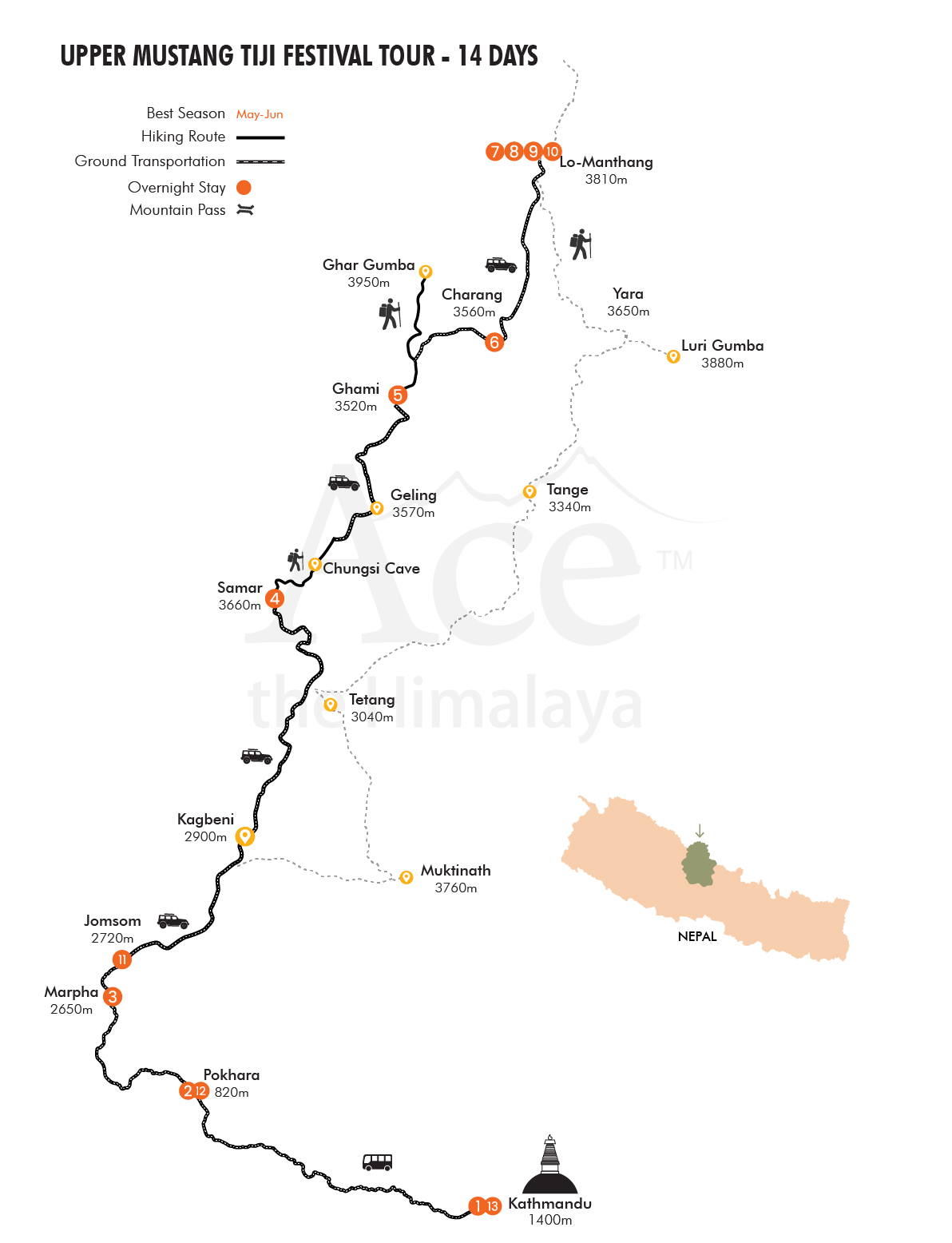
Starting in Kathmandu, the tour begins with a scenic drive to Pokhara, then follows through Marpha, famously known as the Apple Capital of Nepal. Then progresses to Kagbeni, Chhusang, Chele, and Samar.
Along the way, travelers get chance to explore sacred sites such as Chungsi Cave Monastery, Ghar Gompa, and the historic villages of Ghami, Dhakmar, and Charang, offering insight into Tibetan-influenced culture and desert-like Himalayan terrain.
The major highlight of the journey is attending all three days of the Tiji Festival, Upper Mustang’s most important religious celebration. Tiji Festival is held annually in Lo Manthang.
Three days Tiji festival in Lo Manthang features sacred masked dances performed by monks, ritual music, and symbolic ceremonies representing the triumph of good over evil. This unique cultural event draws locals from across Mustang and provides an unforgettable glimpse into centuries-old Buddhist traditions.
After the festival, we return via Jomsom to Pokhara and back to Kathmandu, completing an extraordinary Upper Mustang cultural tour.
The Upper Mustang Tiji Festival tour is perfect for travelers seeking an authentic Himalayan experience, as the itinerary blends festival celebration, light hiking, scenic drives, and deep cultural exploration in one of Nepal’s most restricted and mystical regions.
Detailed Itinerary
Day 01 – May 06 – Arrival at International Airport in Kathmandu and transfer to hotel.
 Max. Altitude: Kathmandu (1,400 m/4,593 ft)
Our airport representative will be receiving you at Tribhuvan International Airport, Kathmandu, and s/he will be displaying an Ace the Himalaya signboard outside the airport terminal. You will then be transferred to your respective hotel in our private tourist vehicle.
Kathmandu has modern facilities including 3-star hotels with hot showers, free Wi-Fi, laundry services, international and local restaurants, reliable phone and internet connectivity.
Note: Either on Day 01 or 02 depending upon your arrival, there will be a pre-trip meeting for your Upper Mustang Tiji Festival Tour. During the meeting we will introduce you to your Upper Mustang tour leader/guide. Please seek this opportunity to ask questions about the tour. We will also supply you with our duffel bag and cap.
For the meeting, please make sure you bring your passport, three copies of passport-size photos, and a readable copy of your travel insurance policy. We will ask you to sign a legally binding trip form as well as a non-liability disclaimer.
-
 Overnight at a 3-star Hotel in Kathmandu
-
 Not included
Day 02 – May 07 – Drive to Pokhara (820 m/2,690 ft) from Kathmandu.
Duration: 7–9 hrs drive
Today after an early breakfast, you’ll take a scenic drive to Pokhara, Nepal’s popular lake city. Our trekking staff will pick you up from the hotel at 6:30 am and escort you to the tourist bus station.
The bus to Pokhara leaves at around 7:30 AM. Pokhara is a beautiful valley set on the banks of Phewa Lake. This route offers spectacular views of terraced farmlands, traditional villages clinging to hillsides, rushing rivers including the mighty Trishuli and Marsyangdi.
Following a scenic 7 to 9-hour drive, you reach Pokhara, a lakeside city that, on clear days, offers breathtaking views of the Annapurna, Dhaulagiri and Machhapuchhre (Fishtail) ranges to the north.
The evening is yours to explore the vibrant Lakeside area of Pokhara, perhaps taking a leisurely stroll along the waterfront, browsing the numerous shops, or simply relaxing at one of the many cafes.
-
Overnight at a 3-star Hotel in lakeside
-
Breakfast included
Day 03 – May 08 – Drive to Marpha (2,650 m/8,694 ft) from Pokhara.
Max. Altitude: Marpha (2,650 m/8,694 ft)
Duration: 5–6 hours' drive
After breakfast in the hotel, today’s journey covers approximately 145 kilometers (90 miles) and takes 5 to 6 hours, following the valley of the Kali Gandaki River. The route passes through beautiful villages like Beni, Tatopani, and Naurikot before reaching Marpha.
You’ll finally reach your destination for the day, Marpha, also referred as apple capital of Nepal. Marpha is renowned for its whitewashed houses, narrow cobblestone alleys, and thriving apple orchards.
In the evening, there will be a short meditation session in a Buddhist Marpha monastery Tashi Lha Khang Gompa. The evening dinner in Marpha provides your first real taste of the high mountain lifestyle and an opportunity to begin adjusting to the altitude before continuing deeper into Upper Mustang.
-
Overnight at a guesthouse.
-
Breakfast, Lunch and Dinner
Day 04 – May 09 – Drive to Samar (3,660 m/12,008 ft) from Marpha via Kagbeni (2,810 m/9,219 ft).
Max. Altitude: Samar (3,660 m/12,008 ft)
Duration: 4–5 hrs drive
Today we start our journey towards Kagbeni, a medieval fortress village that serves as the gateway to Upper Mustang. This fascinating village, with its mud-brick houses, narrow alleyways, and ancient monastery, offers stunning views of Nilgiri peak and deserves a brief exploration and photo stop before continuing.
The drive then continues along the Kali Gandaki River to reach Chhusang (2,980 m/9,777 ft), a village surrounded by dramatic red and grey cliffs. Then, we continue to Chele village (3,050 m/10,006 ft).
Finally, after some time, we reach Samar at 3,660 meters which is the destination for today. Samar is a traditional Tibetan Buddhist village with colorful prayer flags fluttering against the stark landscape.
The evening can be spent acclimatizing to the higher elevation, and marveling at the incredibly clear star-studded sky that defines the high Himalayan night, all while preparing for the hiking that begins tomorrow.
-
Overnight at a Guesthouse
-
Breakfast, Lunch and Dinner
Day 05 – May 10 – Hike to Shyangbochen (3,800 m/12,467 ft) from Samar via Chungsi Cave (3,875 m/12,713 ft). Then drive to Ghami (3,520 m/11,548 ft).
Max. Altitude: Shyangbochen (3,800 m/12,467 ft)
Duration: 4 hrs hike & 2 hrs drive
This day of our Mustang tour includes a hike including drive. The morning starts with a hike from Samar towards Shyangbochen.
The highlight of this morning’s hike is the visit to Chungsi Cave (3,875m), an ancient meditation cave carved into the cliffside that has been used by Buddhist monks for centuries.
The cave features remarkable ancient murals and offers profound insights into the spiritual heritage of this region, along with spectacular panoramic views of the surrounding mountains and valleys.
After the exploration, we hike to Shyangbochen for lunch while enjoying panoramic views of the surrounding valleys. This hike provides close-up views of Mustang’s unique geology and spiritual landmarks.
Afterward, we’ll drive to Ghami passing long mani walls and ancient chortens. The evening provides an excellent opportunity to witness the golden hour of light illuminating the red cliffs that surround Ghami.
-
Overnight at a Guesthouse
-
Breakfast, Lunch and Dinner
Day 06 – May 11 – Hike to Dhakmar (3,820 m/12,532 ft) from Ghami, visit Ghar Gompa (3,920 m/12,860 ft), then drive to Charang (3,560 m/11,679 ft).
Max. Altitude: Ghar Gompa (3,920 m/12,860 ft)
Duration: 2 hrs hike, 2–3 hrs drive
The day begins with a warm breakfast at your Ghami guesthouse. Today’s trek takes you from Ghami to Dhakmar, a village dramatically situated beneath towering red cliffs that give it its name (Dhakmar means “red blood” in the local language).
From Dhakmar, you’ll drive upward to visit Ghar Gompa (3,920 m/12,860 ft), one of the oldest and most significant monasteries in the Mustang region, believed to have been founded in the 8th century by Guru Padmasambhava himself.
This ancient monastery houses remarkable murals, statues, and ancient texts, and if fortunate, you may witness monks performing their daily prayers and rituals.
After exploring this spiritual treasure, you’ll continue driving through spectacular landscapes to Charang village. Charang is one of Upper Mustang’s largest and most historically significant villages, dominated by the imposing Charang Monastery and the former palace of the local chieftain.
-
Overnight at a Guesthouse
-
Breakfast, Lunch and Dinner
Day 07 – May 12 – Drive to Lo Manthang (3,810 m/12,500 ft) from Charang.
Max. Altitude: Lo Manthang (3,810 m/12,500 ft)
Duration: 2–3 hrs drive
Today marks a significant milestone in your journey as you drive from Charang to Lo Manthang, the ancient walled capital of the former Kingdom of Lo and the main highlight of your Upper Mustang adventure.
After breakfast, enjoy a scenic 2 to 3-hour drive across the high desert plateau to reach Lo Manthang. As you approach the city, the sight of its massive earthen walls rising dramatically from the barren landscape is truly awe-inspiring.
Lo Manthang is home to four major monasteries: Thubchen Gompa, Jampa Gompa (Jampa Lhakhang), Chodey Gompa, and Choprang Gompa, each preserving priceless murals, statues, and ancient manuscripts dating back to the 15th century.
The rest of the day is free to explore the walled city at your own pace. You may visit the King’s Palace, explore all four monasteries, and possibly witness the vibrant preparations for the upcoming Tiji Festival, offering a deeper insight into Mustang’s living cultural traditions.
-
Overnight at a Guesthouse
-
Breakfast, Lunch and Dinner
Day 08 – May 13 – Attend the first day of Tiji Festival.
Max. Altitude: Lo Manthang (3,810 m/12,500 ft)
This morning holds special excitement as you’ll witness the opening day of the Tiji Festival, Upper Mustang’s most important religious ceremony and cultural celebration.
After breakfast, you’ll make your way to the main courtyard of Chodey Gompa or the central plaza where the festival performances take place.
Tiji, derived from the Tibetan word “Tempa Chirim” meaning “Prayer for World Peace,” is a three-day ritual that celebrates the victory of Buddha’s incarnation, Dorje Jono, over a demon who was causing drought, famine, and other hardships in Mustang.
The first day’s Tiji festival ceremony starts at noon with the ritual of “Tsa Chham,” where monks wearing magnificent brocade robes and fearsome masks representing various deities perform intricate dances.
The atmosphere is surrounded by traditional musical instruments including horns, drums, and cymbals. Between dance sequences, you’ll have opportunities to photograph the performances, interact with local families, and observe the deep devotion with which the community participates in these ancient rituals.
After the day’s ceremonies, conclude the day by reviewing photographs, journaling about the day’s extraordinary experiences, and discussing the symbolic meanings of the dances with your guide before resting for tomorrow’s continuation of the festival.
-
Overnight at a Guesthouse
-
Breakfast, Lunch and Dinner
Day 09 – May 14 – Attend second day of Tiji Festival in Lo Manthang.
Max. Altitude: Lo Manthang (3,810 m/12,500 ft)
The second day of the Tiji Festival continues the sacred ceremony, as the ritual story moves deeper into the battle between good and evil. You can enjoy a relaxed breakfast at your guesthouse, as the ceremonies begin after noon.
Today’s performances of Tiji festival known as “Nga Chham,” feature more aggressive and dynamic dance movements representing Dorje Jono’s pursuit and ultimate defeat of his demon father (Ma Tam Ru Ta).
The dances become more complex, performed by highly trained monks in precise, synchronized movements, accompanied by the deep sounds of Tibetan horns, drums, and cymbals.
The ceremonies usually end around 5:00 PM, after which you return to your guesthouse for dinner and a warm evening at high altitude, reflecting on the day’s unforgettable cultural experience.
-
Overnight at a Guesthouse
-
Breakfast, Lunch and Dinner
Day 10 – May 15 – Attend the third day of Tiji Festival in Lo Manthang.
After breakfast in Lo Manthang, you’ll gather for the third and final day of the Tiji Festival, the most dramatic and impressive day of this sacred event in Upper Mustang.
Known as “Rha Chham,” today’s ceremonies mark the symbolic victory of good over evil. The highlight of the day is the ritual destruction of a black effigy, representing the defeated demon.
Accompanied by powerful masked dances, traditional Tibetan horns, drums, and chants, the effigy is carried in procession and ceremonially destroyed outside the city walls, believed to cleanse the region of negative forces and bring blessings for the year ahead.
In the evening, you’ll return to your guesthouse for a farewell dinner in Lo Manthang, reflecting on the rare cultural experience of witnessing the Tiji Festival in Upper Mustang.
-
Overnight at a Guesthouse
-
Breakfast, Lunch and Dinner
Day 11 – May 16 – Drive to Jomsom (2,720 m/8,923 ft) from Lo Manthang.
Duration: 5–6 hrs drive
After breakfast in the ancient walled city of Lo Manthang, you’ll begin the scenic 5 to 6-hours’ drive to Jomsom, retracing your route through the dramatic landscapes of Upper Mustang.
Passing familiar villages such as Charang, Ghami, Samar, and Chele, the journey offers a new perspective on the barren hills, eroded cliffs, and high-desert settlements you have come to know.
As you descend toward Kagbeni and into the Kali Gandaki Valley, the landscape gradually becomes greener and the air thicker at lower elevations.
You finally reach Jomsom in the late afternoon, where the journey shifts from the remote simplicity of Upper Mustang to a place with greater comfort and connectivity.
-
Overnight at a Guesthouse
-
Breakfast, Lunch and Dinner
Day 12 – May 17 – Drive to Pokhara (820 m/2,690 ft) from Jomsom.
Max. Altitude: Pokhara (820 m/2,690 ft)
Duration: 7–8 hrs drive
Today, we retrace our steps toward where we started, Pokhara. The route descends rapidly through the Kali Gandaki Valley, following the same journey made ten days ago, but now with enriched spirits, and cameras filled with extraordinary images from one of the world’s most restricted regions.
Passing through the same beautiful villages such as Marpha, Tukuche, Tatopani, and Beni, the return journey showcases a dramatic change in landscape, as the dry high-altitude terrain of Upper Mustang gradually gives way to lush hills, warmer temperatures, and subtropical vegetation.
After a long 7 to 8 hours’ drive, we finally reach Pokhara, check into a hotel in Lakeside, and enjoy a restful evening with views of Phewa Lake or a leisurely stroll along the lakeside.
-
Overnight at a Guesthouse
-
Breakfast, Lunch and Dinner
Day 13 – May 18 – Drive to Kathmandu (1,400 m/4,593 ft) from Pokhara.
Max. Altitude: Kathmandu (1,400 m/4,593 ft)
Duration: 8–9 hrs drive
After early breakfast at your hotel, we begin the scenic drive from Pokhara to Kathmandu, a journey of approximately 8 to 9 hours that winds through river valleys, terraced hillsides, and traditional villages.
The route follows the Marsyangdi and Trishuli rivers, offering changing landscapes from lush countryside to bustling roadside towns, with several stops along the way for refreshments and lunch.
As you approach Kathmandu, the scenery gradually shifts to a more urban setting, marking your return to the capital city, where you arrive by late afternoon.
A short farewell dinner will be organized on your last day in Nepal, offering a pleasant opportunity to celebrate your journey with your trekking guide or our company staff.
-
Overnight at a Guesthouse
-
Breakfast, Lunch and Dinner
Day 14 – May 19 – Transfer to International Airport for your final departure
It’s the end of our exciting journey in the Mustang Region! Today we conclude our Upper Mustang Tiji Festival Tour.
One of our airport representatives will accompany you to the International Airport for your flight back home. We bid you farewell and hope you’ll travel to Nepal again.
-
Overnight at a Guesthouse
-
Breakfast, Lunch and Dinner
Price Includes
Accommodation
- Twin-sharing/double accommodation in a 3-star hotel for in Kathmandu for 2 nights and a 3-star hotel in Pokhara for 2 nights including breakfast (Private room accommodation can be organized at an extra cost)
- Twin-sharing or dormitory guesthouse accommodation during the tour for 9 days in the mountains.
Meals & Drinking Water
- All your standard meals during the trek (Breakfast, Lunch, and Dinner) including seasonal fruits
- A farewell dinner on the last night in Nepal
- Purified drinking water during the trek using water filter or water purification tablets.
Transportation and Domestic Flight
- Tourist bus between Kathmandu and Pokhara
- All ground transportation in the mountain, as specified in the itinerary, is provided by locally available vehicles, the majority of which are Indian vehicles such as the Mahendra Scorpio and Bolero
Guide and Staff
- Experienced, wilderness first-aid trained, government licensed, English speaking, and locally recruited Ace the Himalaya’s trekking guide (2 guides for group size more than 7 people).
- Porters during the trek for carrying luggage (1 porter for every 2 clients)
- Wages, accommodation, meals, gear, insurance, and medications for all staff
Permits
- Annapurna Conservation Area Permit
- TIMS (Trekkers’ Information Management System) card
- Upper Mustang Restricted Area Permit (RAP)
Benefits and Takeaways
- A comprehensive first aid kit, including an Oximeter to check pulse and oxygen levels daily in the mountains
- 1 Ace the Himalaya’s duffel/kit bag, trekking map, sun hat, Buff (Neck Gaiter)
- Trip completion certificate
Administrative & Taxes
- All administrative expenses and government taxes
Price Excludes
Excludes
- Meals (lunch and dinner) in Kathmandu and Pokhara
- International flight fare and airport departure tax
- Nepal Entry Visa (Visa can be acquired easily after your arrival at Tribhuvan International Airport in Kathmandu with a fee of USD 30 for 15 days visa, USD 50 for 30 days visa and USD 125 for 90 days visa)
- Travel insurance along with high-altitude emergency evacuation coverage
- Any beverages including bottled and boiled water
- Tips to trekking staff and driver
- Personal trekking gear and equipment
- Any expenses other than the Price Include section
Gears and Equipment
Here is a list of what you might want to pack for the Upper Mustang Tiji Festival tour. Please take this as a starting point. You’ll need layers of warmer clothing during the winter. We provide a 75-liter duffel bag for you to use for the trek. It will be given to you during your pre-trip meeting in Kathmandu. The duffle bag is yours to keep. Also, you can rent sleeping bag and down jacket with us at the additional fee of USD 35 for each once you are in Kathmandu.
General
- Puffy down jacket (We have rental jackets available for an additional USD 35)
- Four-season (zero degree) sleeping bag (We have rental sleeping bags available for an additional USD 35)
- Daypack (35-45 liters recommended) with rain cover
- Sleeping bag liner
Upper Body
- Sun hat or cap (We’ll provide you with a free Ace the Himalaya baseball cap.)
- Knitted hat/Beanie
- Headlamp
- Sunglasses (UV protection highly recommended)
Torso
- Technical fabric base layer (light for warmer months, heavy for colder months)
- Technical fabric short (2) and long sleeve shirts (2)
- Waterproof, windproof shell jacket
- Fleece jacket or pullover
Lower Body
- Technical fabric base layer (lightweight for warmer months, heavyweight for colder months)
- Hiking pants (2 pairs)
- Comfortable pants for inside teahouses
- Waterproof, windproof shell pants
- Hiking shorts
Hands
- Wool or technical fabric liner gloves
- Hard-shell outer gloves (insulated for colder months)
Feet
- Wool or technical fabric warm socks
- Hiking socks
- Liner socks (optional such as silk)
- Trekking/hiking boots (waterproof recommended)
- Ice Cleats /Micro Spikes
- Casual shoes or sandals (for evening)
- Gaiters (lightweight for dust or heavy for snow in colder months)
Undergarments
Note: The quantity of each article of clothing can be adjusted to suit the preferences of each participant.
- Technical fabric/quick drying is best for underwear (opportunities to launder during the trip)
- Sports bras (women)
- Pajamas or sleeping clothes
First Aid Kits and Medications
(Note: Guides carry medications and first aid kits during the trip. However, personal kits and medications are highly recommended.)
- Sunscreen
- Lip balm
- Ointments (blister care, antiseptic cream)
Other Essentials
- Passport
- Extra copies of passport-sized photos
- Reusable water bottle
- Toiletry kits
- Water purification tablets or UV water purifier (recommended to treat water)
- Hydration bladder
- Towel
- Pillowcase
- Toilet paper (2 rolls)
- High protein snacks (such as protein bars, or nuts)
- Waterproof/dry bags for carrying important documents and money
- Airline tickets (Please leave a copy at our office in Kathmandu. This can be useful if there is a change in the date of the flight.)
- Earplugs
- Trekking poles
Optional
Once in Nepal, if you have the time, you can purchase supplies and gear for trekking or hiking. Thamel, Kathmandu’s tourist hub, is home to many shops where you can get a variety of reasonably priced necessary equipments.
- Power bank or extra batteries
- Cameras and mobile phone
- Cards/book
- Binoculars (for wildlife and mountain views)
- Whistle
- Thermos for hot water
- Comb
Note: Some clothing, especially form-fitting, figure-hugging items made of elastic material (like yoga pants), may offend locals. Therefore, if you choose to wear these clothes for comfort, please make sure to wear something over them.
Important Information
- We give you a free duffel bag and baseball cap during your pre-trip meeting in Kathmandu. The duffel bag will be used to pack your trekking supplies.
- For every two participants, we assign one porter. The duffel bag, which should weight around 10 kg/22 lbs, will be carried by the porter throughout the walk.
- To carry your daily necessities like cash, crucial papers, a water bottle or bladder, a camera, toiletries, sunscreen, a notebook, clothing, etc., you must have your own daypack (with a waterproof cover).
- You can store your luggage (non-trekking items) at the hotel in Kathmandu.
- Down jacket with a hood is a must for altitudes above 4,000 m to keep warm. You can rent a down jacket for USD 35. Please note that in case of loss or damage, you need to reimburse the cost of USD 200 per item.
- You can rent a 4-season sleeping bag for USD 35. Please note that in case of loss or damage, you need to reimburse the cost of USD 200 per item.
FAQs for Upper Mustang Tiji Festival Tour 2027
General
Is this departure guarantee to run?
A minimum of two participants are required per departure date as the price is quoted based on a minimum of 2 customers due to the Upper Mustang restricted area permit. If you are the only person booked for a particular departure, you have the option to either pay a supplement fee of USD 850 to maintain your solo departure.
Why trek with Ace the Himalaya?
Ace has a reputation for successfully leading treks and tours with knowledgeable leaders and staff taking care of all your travel needs. We are a certified sustainable travel company that also endorses the idea of giving back to the community by participating in various philanthropic activities. Here are 17 reasons why you should choose Ace the Himalaya for your next adventure!
What additional documents do I need?
- Two passport-sized photos (2×2 inch) to give to our office staff
- A copy of your international flight ticket to give to our office staff
- A copy of travel insurance to give to our office staff
Do we book our own international flights to and from Nepal?
Yes, you need to book your own international flights. We are a local agent and it would cost you significantly higher to book through us. Please find more information in the International Flight page.
Is hiring a guide necessary for Upper Mustang Tiji Festival tour?
Our Upper Mustang Tiji Festival Tour is fully guided and traveling with a licensed guide is mandatory in Upper Mustang. Upper Mustang is a restricted region of Nepal, and government regulations require all visitors to enter with a special permit and an authorized guide.
Our experienced guide takes care of all permits and logistics, assists in unexpected situations, and enriches your journey with deep insights into the region’s unique culture, history, monasteries, and the sacred Tiji Festival ensuring a safe, legal, and truly meaningful experience.
Can the guide speak English?
Yes, our guides can speak English. Most of them start their careers as porters and work for 3 to 4 years before becoming trekking guides. Their English skills are based on real-world experience rather than formal education. While they are able to communicate effectively, please note that English is not their first language, so their fluency may not be on par with native speakers. They will also assist with communication, especially since many locals, like shopkeepers and teahouse hosts, may not speak English.
Weather and Temperature
What is the ideal time to experience the Tiji Festival in Lo Manthang?
The ideal time to experience the Tiji Festival in Lo Manthang is May, when the weather is stable, skies are clear, and daytime temperatures are comfortable, perfect for enjoying the festival and the scenic region.
In general, Upper Mustang is best visited from March to May and September to November, as the region lies in a rain-shadow area and remains dry with good visibility and pleasant daytime conditions.
What is the weather like in Upper Mustang during the Tiji Festival?
During the Upper Mustang Tiji Festival Tour (usually held in May), the weather is generally dry, stable, and pleasant due to Mustang’s location in the Himalayan rain-shadow zone.
Daytime temperatures in Lo Manthang and surrounding areas typically range between 12°C to 20°C (54°F to 68°F), making it comfortable for sightseeing and festival activities. Nighttime temperatures can drop significantly, usually falling to around -5°C to 5°C (23°F to 41°F), so warm layers are essential for evenings and early mornings.
What is the temperature rating of the sleeping bag that you lend to trekkers?
The temperature rating of the sleeping bags that we rent to trekkers is about -15 °C (5 °F). Also, our guides can obtain extra blankets if needed at the teahouses.
Arrival and Visas
Is it possible to obtain a visa for Nepal upon arrival at the airport?
Yes, you can obtain a Nepal visa upon your arrival at the airport. There are kiosks in the arrival hall that you use to complete the necessary forms. The cost is USD 30 for a 15-day tourist visa, including numerous entries, or USD 50 and USD 125 for a 30-day or 90-day tourist visa including numerous entries respectively. You should carry cash (USD) with you to pay your visa fees quickly and easily, as digital payments are frequently unavailable.
To save time, we recommend filling out the online visa application form in advance. Applying online 2 weeks before your arrival will expedite the process at the airport. For detailed guidelines, please refer to our blog titled Guidelines for Online Tourist Visa Form in Nepal.
Who will come to pick me up at the airport upon my arrival?
Our staff will be waiting for you outside the airport terminal with our signboard (Ace the Himalaya). You will be accompanied to a hotel in a private tourist vehicle.
PAYMENTS AND EXTRA COSTS
How much additional money do I need per day?
For the Upper Mustang Tiji Festival Tour, you should budget approximately USD 15 to 20 per person per day for personal expenses. This is for purchasing snacks and covering lunch or dinner expenses in Kathmandu and Pokhara. If you wish to buy souvenirs or native Nepali goods, it’s advisable to bring extra cash with you.
Is it possible to use credit cards in the places I visit during the trek?
In Kathmandu and Pokhara, yes – to some extent. Once you are out of the cities, all you need is cash. Please change the currency in local Nepali Rupees before you go to the mountains.
Is it possible to reserve a trip now and pay a deposit later, or do I have to pay a deposit at booking/reservation?
When you book, you must pay a 30% deposit to secure your itinerary. The remaining balance can be paid upon your arrival at Kathmandu or before arrival. US Dollars cash and credit cards (Visa, Mastercard, and American Express) are accepted once in Nepal. Please note a 4% transaction fee will be added for all credit card transactions.
How do I pay the remainder of my balance upon arrival in Kathmandu? US Dollars cash or credit card?
You can make payments via US Dollars cash or credit card (Visa, Master, and American Express). A 4% transaction fee is added if paying with a credit card. Thus, we encourage you to pay with USD cash if you are planning to pay upon your arrival in Kathmandu.
We prefer you pay with larger bills (USD 50 or 100). Please note that the cash should not be older than 2009 and in good condition, as banks do not accept worn, torn, or crumpled bills.
How are the ATM and money exchange facilities in Kathmandu and Pokhara?
There are ATMs and money exchange facilities almost every few meters in Thamel, where you’ll be staying in Kathmandu, and Pokhara as well. So, you can easily use your cards to cash out the limited sum of money, for which a minimum charge is deducted by the ATM facility itself. Additionally, you can easily exchange your foreign currencies in currency exchange centers for an exact rate both in Kathmandu and Pokhara.
WHO CAN PARTICIPATE?
Do I need prior hike experience to participate?
No prior hikking experience is required for the Upper Mustang Tiji Festival Tour. This is primarily a guided cultural and jeep-supported tour with short and easy walks to monasteries, villages, and festival venues.
As long as you are in good health, comfortable with high-altitude travel, and able to handle bumpy mountain roads, you can enjoy this journey.
Are there any age requirements for this tour?
There are no strict age restrictions for the Upper Mustang Tiji Festival Tour. Participants should be physically fit and medically cleared for high-altitude travel. We have welcomed families with children as well as senior travelers, provided they are in good health, adaptable to high-altitude conditions, and travel with a flexible and positive mindset.
Is the Upper Mustang Tiji Festival Tour safe for solo female travelers?
Yes, the tour is safe for solo female travelers. Upper Mustang is culturally conservative but welcoming, and this tour is fully guided in a restricted region, ensuring constant support and supervision.
Traveling with Ace the Himalaya provides an added layer of safety, local assistance, and reliable logistics, making it a comfortable and secure experience for solo women travelers.
PHYSICAL FITNESS
How challenging is the Upper Mustang Tiji Festival tour?
The Upper Mustang Tiji Festival Tour is considered a moderate-level cultural tour rather than a trekking expedition. The journey is primarily a jeep-supported drive tour with a few short and easy walks to villages, monasteries, and festival venues.
While there is no strenuous trekking involved, travelers should be prepared for bumpy mountain roads, long driving days, and high-altitude conditions (up to around 3,800 meters in Lo Manthang).
With basic fitness, a flexible mindset, and proper acclimatization, the tour is suitable for most travelers interested in experiencing the Tiji Festival in Upper Mustang.
What kind of physical training is necessary for tour preparation?
The Tiji Festival Tour does not require strenuous training, but basic fitness is helpful. Regular walking, light hiking, jogging, or cycling a few times a week before the trip will prepare you for short walks, long drives, and high-altitude conditions.
TIJI FESTIVAL TOUR PREPARATION AND PACKING
What are the procedures after I make my deposit?
After making the deposit, one of our staff will email you for further information. We will require a copy of your passport photo page and your arrival/departure flight details. We will also provide you with additional trip information.
What sort of insurance do I need? How can I obtain a policy?
Travel insurance is mandatory for our hiking itineraries. We require your policy have medical evacuation coverage for the maximum elevation of your itinerary. Insurance may also cover additional costs in the event of a flight delay or cancellation caused by bad weather, medical costs, theft, loss, and damage to your items while traveling.
Travel insurance can be obtained online by one of several travel insurance companies. Please note that insurance obtained from an airline at the time of booking your flight may not cover medical evacuation coverage.
What are the necessary items that I should pack for my trip?
You can find the necessary items to pack for the trek here in the Equipment section. Gear and equipment can be bought or rented upon your arrival in Kathmandu. If you plan on buying or renting gear in Kathmandu, please allow extra time.
Do you provide sleeping bags or down jackets for rent?
Yes, we do provide sleeping bags or down jackets for rental costs of USD 35 each. Do let us know before initiating the trek and we shall provide items. You can view the photos of the gear at this link: Photos of the Gear.
What type of bag will the porters carry?
We provide you with a free duffel bag of 70 to 80-liter capacity that our porters will carry. The maximum weight that porters can safely carry is 30kg, and each porter is assigned to two people.
However, each porter carries a maximum of 25 kg/55 lbs in total during the trek period. Your duffel bag, which should weigh no more than 12.5 kg/27.56 lbs per client, will be carried by the porter throughout the trek.
What type of daypack should I bring?
We suggest a 30 to 40-liter capacity daypack. Wider straps and hip belts are recommended to assist you in carrying weight evenly and reduce pain.
What about my passport, medications, and belongings?
Bring copies of your passport, insurance papers, and other essential items in your carry-on during your international flight. If you need to take medications daily, keep them in your daypack with your other essential possessions. You can store other non-trekking essentials in the office of Ace the Himalaya or at the hotel in Kathmandu.
ACCOMMODATION
What kind of lodging is available in Kathmandu, Pokhara, and on the tour?
In Kathmandu and Pokhara, we accommodate our guests in well-rated 3-star hotels that include daily breakfast. In tour and trek days, you’ll be staying at the guesthouses.
During your stay in Kathmandu, we typically use Hotel Thamel House, Hotel Jampa, or other comparable quality hotels. In Pokhara, you’ll stay at Hotel Hidden Kingdom or a similar standard property.
You can upgrade the accommodation to a 5-star hotel for the stay in Kathmandu and Pokhara for an additional charge.
Is it possible to have private room during tour or while in Kathmandu and Pokhara?
A private room in the teahouses cannot be guaranteed during peak season. During the non-peak season, the teahouses may provide a private room without any additional cost. The accommodation during the trek will remain very basic with twin sharing rooms and occasionally dormitory rooms for our trekkers.
We can arrange for a private room while in Kathmandu and Pokhara for an additional cost of USD 35 per room per night.
What happens if I end up staying an extra night/s in Kathmandu due to an unforeseen delay or cancelation?
In case of unforeseen circumstances such as flight cancellation, your health, or for any reason you decide to discontinue the trip and arrive early in Kathmandu then you will need extra accommodations in Kathmandu.
The cost of the teahouses in the mountains is not equivalent to the cost of a hotel in Kathmandu or Pokhara. In such cases, we will arrange your accommodations, but you will need to pay a supplemental charge.
What are the Toilet facilities in the tea house/guesthouse?
Most of the tea houses do have western style flushing toilet however in higher elevation you could find the squat toilets made of either a ceramic basin on the ground or few planks precariously positioned over a hole in the ground which is always outside of the room.
Attached toilets are available in some guesthouses, while in others they are shared or located outside the room, depending on the location and available facilities.
What sort of food can I expect in trekking?
Multiple food choices are available in the stat at Nepal. For lunch and dinner, there are many restaurants in Kathmandu and Pokhara. They provide Continental, Chinese, Mexican, and American-based cuisines with some local influences.
You will always have plenty of options to choose from. The hotel where you will stay will provide breakfast, which is included in the package. You will need to pay your own for lunch and dinner and any other food items in Pokhara and Kathmandu.
Options include daal bhat (rice and lentil), bread, eggs, potatoes, noodles, soup, pasta, and pastries. You can purchase an additional hot drink or sometimes soda at your own expense and also purchase candy or cookies (crisps).
Can I shower/bathe during the tour?
Yes, you can shower during the Upper Mustang Tiji Festival Tour. In places where your room has an attached bathroom, you can shower there as usual. In villages with shared or common bathrooms, hot showers are available for an additional charge, typically USD 5 to USD 8 per shower, depending on the location.
Can I charge my electronic equipment during the tour?
Yes, you can charge your electronic equipment during the Upper Mustang Tiji Festival Tour. Most guesthouses provide charging facilities, usually in dining areas or common spaces and in your room too.
We recommend bringing two-pin (Type C) and three-pin (Type D) adapters, as these are commonly used in Nepal. You can bring them from home or easily purchase them in Kathmandu before the trip begins.
HEALTH AND SAFETY
Do your guides have the trekking guide certificates from the Hotel Management and Tourism Center? Have they received first aid training for high altitudes?
We provide licensed trekking guides with fluent English. Our guides are certified by the Hotel Management and Tourism Center after receiving 45 days of training. Similarly, the guides receive high-altitude training from Kathmandu Environmental Education Project (KEEP).
Is Ace the Himalaya a member of the Nepal Tour and Travel Agencies Association?
Yes, in fact, our company is an active member of the Nepal Tour and Travel Agencies Association.
Is Ace the Himalaya's staff insured?
Our company insures all our trekking staff members, including tour guides, cooks, Sherpa, and porters. Please browse through our legal document page to view insurance details.
What vaccinations will I need?
While no vaccinations are strictly mandatory for travel to Nepal, it is highly advisable to take precautionary measures to protect your health. To ensure a safe and enjoyable trip, we recommend the following vaccinations: Routine Vaccines, Malaria, Japanese Encephalitis, Hepatitis A, Hepatitis B, Typhoid, Rabies, Cholera, etc.
It is also helpful if you inform us of any medical condition that is relevant, so we may convey this information in the event of an emergency. Ace the Himalaya keeps your medical condition confidential unless treatment is necessary.
Do you guys have a PAC (Portable Altitude Chamber)?
Yes, we have access to a portable altitude chamber in case of an emergency. It is not essential to carry during the trek. Though, we can use arrange it upon request for an extra cost of USD 200.
PRACTICAL MATTERS
What is your cancellation policy?
Notice should be provided 20 days before the trip start date in case of cancellation. The trip can be canceled for justifiable reasons. Once the trip is canceled, a fee of 30% of the trip cost is retained for administrative costs.
However, the trip amount is entirely non-refundable if the cancellation is not made before the 20 days as per our terms and conditions. For submitting a claim to your insurance company after the cancellation, we can assist with documentation such as a receipt of monies paid. Refund will not be provided for unused accommodation in case of trip cancellation caused by personal reasons/sickness/weather.
More information about our cancellation policy can be found here in Terms and Conditions page.
Do I need to tip my guide and driver? How much would that be?
Tips are always expected. It is a small gesture of thanks to the field staff towards the end of the tour USD 20 per guide and USD 10 per driver per day is recommended per group, but it is entirely up to your wishes.
Is there any communication while we are on tour?
Yes, most guesthouses in Upper Mustang offer Wi-Fi and mobile network coverage, though signals can be weak or intermittent in remote areas.
Does it cost an extra amount if I am a solo traveler?
If you are a solo traveler and book one of our published dates, there is no additional fee. If you sign up for a private trip or change the trip date from one of our published trip dates, you will be charged an additional fee.
Is there a provision for a refund policy if I don't accomplish the tour?
When you fail to complete the journey for medical or personal reasons. In this situation, be aware that we do not issue any refunds for products purchased or unused tour days. We must pay our administration staffs, guides, and porters, purchase trekking permits, and all other booked accommodations in advance, so our expenses remain the same.
Who else will be joining my tour group?
If there are any, you will be allocated to a tour group. The details of the personal data of your group members cannot be disclosed.
However, feel free to contact us if you have queries about other trekkers in the group and we shall give you a general idea of the ages, nationality, and sex of your group members.
Can I add extra days to my trip?
You can extend your trekking trip for an additional cost. Potential arrangements will be made if we get a request from your guide. This is applicable for private or solo trips as the itinerary can be easily adjusted.
The addition of extra days is bound by time when you are in a group. Therefore, discuss with your group and guide, what changes can possibly be made.
I want to extend my holiday, any recommendations?
Yes, you can extend your holiday. Ace the Himalaya offers many options and alternatives for your holiday extension. For more information, you can visit our Day trips pages.
TRANSPORTATION AND FLIGHTS
Do I need to book my international flights for the travel to Nepal?
Yes, you must book your international flights. We are a local agency and do not make international flight arrangements. You can easily browse through flight tickets in airlines sites to book ones most feasible for you.
What form of transportation do you utilize?
We utilize private tourist vehicles for touring and airport pickups. Depending on the group size we use cars, minibuses, vans, and tourist buses to and from Kathmandu/ Pokhara.
All the vehicles are usually air-conditioned unless you are traveling in cooler areas.
What makes this trip different ?
Our CSI with Sambhav Nepal
Ace the Himalaya supports the communities that make tourism in Nepal possible. Since 2007, we have partnered with Sambhav Nepal a local NGO, founded by our MD & CEO Prem Khatry, supporting education, health, women’s empowerment, disaster relief, and community volunteer programs.
Sambhav Nepal Major Works (Till October 2026)
- Supported 25,000+ students in Gorkha District community schools with winter clothing, school bags, and other supplies.
- Established and supported 10 health laboratories, benefiting 230,000+ people.
- Empowered 8,000+ women through cultural promotion and livelihood development projects.
- Provided 13 ambulances and served as a frontline responder during the 2015 earthquake, COVID-19, floods, landslides, and other disasters.
- Supported 34+ students in pursuing PCL-level higher education.
- Built or supported 75+ houses for earthquake-affected households, and rebuilt school buildings and hostels benefiting 4,500+ students.
Sustainability and Responsible Tourism
- Ace the Himalaya is one of the few Travelife Certified companies in Nepal. Our treks are socially and environmentally conscious, leaving the lowest possible impact in the Himalayas.
- On most of our treks, we provide filtered water wherever running water is available, helping reduce single-use plastic bottle waste in the mountains.
- Trekkers are given garbage bags during treks to carry out their waste and keep the trails clean.
- About 80% of our staff are natives of the regions where our trips are organized. This helps local communities, supports small businesses, and promotes regional culture and ways of life.
Contact Us
Head Office
Trip Map